
Navigating Estate Planning Strategies During Uncertain Policy Times


Following years of diligent saving, prudent investing, and careful wealth accumulation, a crucial question emerges: how should these assets transfer to the next generation? Estate planning addresses this fundamental concern. While investors typically begin by concentrating on asset allocation and retirement preparation, they frequently postpone decisions about posthumous asset distribution. This delay has grown more expensive as estate taxation rules have experienced substantial modifications, with recent Congressional action potentially extending existing estate tax frameworks.
Estate planning represents one of the most neglected yet essential elements of holistic financial strategy. This consideration applies to all households, whether they oversee significant investment portfolios or simply aim to transfer assets to beneficiaries in the most effective manner. Grasping these changing regulations and implementing suitable approaches can determine whether wealth preservation succeeds for future generations and philanthropic endeavors, or whether substantial portions disappear through taxation.
Estate planning encompasses complexities that reach far beyond drafting a basic will. This discussion will examine key factors including tax efficiency, asset safeguarding, and ensuring your financial heritage reflects your principles and goals. For investors, this creates both obstacles and possibilities to organize their affairs in ways that optimize transfers to beneficiaries.
Current Federal Estate Tax Thresholds Reach Unprecedented Levels
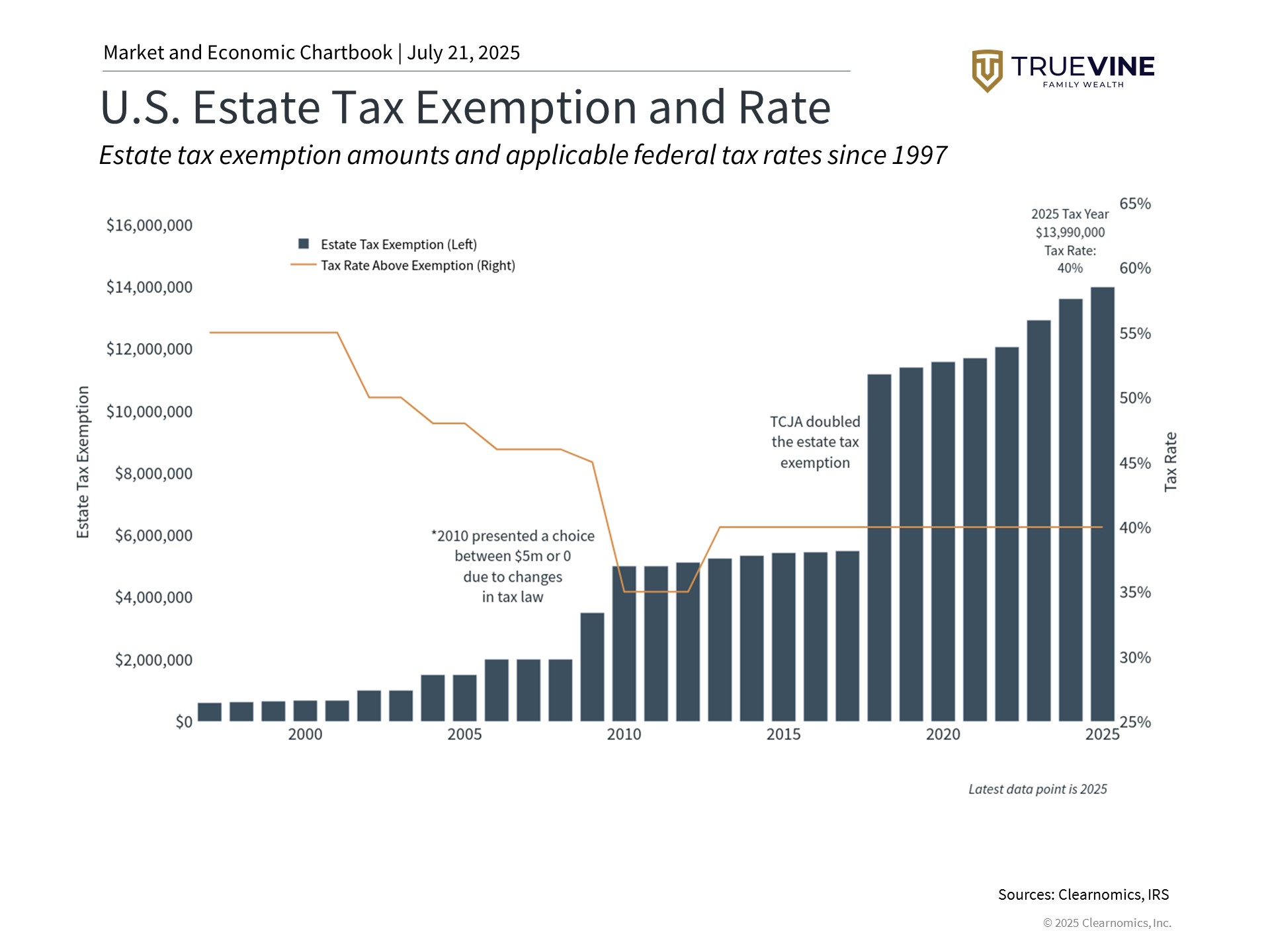
Presently, individuals may transfer up to $13.99 million to beneficiaries without incurring federal estate taxation, while married pairs can move up to $27.98 million. These threshold amounts, established through the Tax Cuts and Jobs Act of 2017 and annually adjusted for inflation, constitute some of the most generous limits in American history.
Absent Congressional intervention, these measures would expire at 2025’s conclusion, causing exemptions to return to their 2017 amounts of roughly $5.49 million per person, with inflation adjustments. Nevertheless, the current budget approved by the House of Representatives would permanently extend these measures while expanding them to $15 million for individuals and $30 million for married couples starting in 2026. These figures may shift during Senate deliberations.
The included chart illustrates how estate tax exemptions and rates have changed historically. Particularly significant is that while exemption amounts have risen substantially, the maximum tax rate of 40% has remained fairly consistent recently. This establishes considerable planning potential for families whose estates might surpass future threshold levels.
Annual Giving Approaches Can Reduce Estate Tax Exposure
For households with considerable assets, yearly gifting constitutes one of the most direct methods to minimize future estate tax obligations. The 2025 annual gift tax exclusion permits individuals to provide up to $19,000 per beneficiary without consuming their lifetime exemption. This allows a married couple with five grandchildren to jointly transfer $190,000 annually without tax implications, systematically reducing their taxable estate.
Consistent gifting’s effectiveness becomes most evident across extended periods. Families maximizing annual exclusions over decades can move millions while avoiding both gift and estate taxation. This approach gains additional value when paired with appreciating assets, since future growth would occur beyond the taxable estate’s reach.
Apart from annual exclusions, the current lifetime gift tax exemption of $13.99 million creates further planning possibilities. Some families choose substantial current gifts to secure present exemption levels in anticipation of potential future legislative changes. Naturally, this strategy demands careful evaluation of future financial requirements and the family’s comprehensive objectives.
State Taxation Rules Introduce Additional Complications
Although federal estate taxation impacts only the most affluent families, state-level taxes can affect broader estate ranges. Consequently, residence choices carry significant tax consequences. Florida and Texas, for instance, impose no state estate taxes, while New York and Massachusetts maintain lower exemption thresholds than federal standards.
State tax regulations also evolve regularly, creating another uncertainty layer for long-term planning. Today’s tax-efficient strategy might become less beneficial if state legislatures alter their estate taxation approach. This emphasizes the necessity of periodic plan evaluations and maintaining adaptability in estate planning frameworks.
Trust Structures And Sophisticated Techniques Offer Adaptability
Beyond basic wills, estate planning frequently incorporates trusts and other sophisticated methods. Irrevocable life insurance trusts, for example, can exclude life insurance payouts from taxable estates. Charitable remainder trusts can deliver beneficiary income while creating tax deductions and advancing philanthropic objectives.
Furthermore, the stepped-up basis rule continues providing substantial benefits for inherited assets. This regulation adjusts inherited property’s cost basis to fair market value at the owner’s death, potentially eliminating capital gains taxes on appreciation during the original owner’s lifetime. Though this provision has encountered political opposition, it remains active and represents a crucial estate planning consideration.
The unpredictable economic and political climate highlights estate planning’s importance. With asset valuations at high levels, interest rates offering appealing cash returns, and historically favorable tax provisions, families possess numerous options for structuring wealth transfer approaches.
The bottom line? Estate planning has never been more critical, while simultaneously becoming increasingly sophisticated. Every family should examine their estate planning periodically as part of their complete financial strategy.

This blog is published by TrueVine Family Wealth. The firm is registered as an investment adviser with the state of Florida and only conducts business in states where it is properly registered or is excluded from registration requirements. Registration is not an endorsement of the firm by securities regulators and does not mean the adviser has achieved a specific level of skill or ability. The firm is not engaged in the practice of law or accounting.
Information presented is believed to be factual and up-to-date, but we do not guarantee its accuracy and it should not be regarded as a complete analysis of any subjects discussed. All expressions of opinion reflect the judgment of the authors on the date of the post and are subject to change. Blog posts were prepared by Clearnomics, a third-party content provider.
You should consult with a professional advisor before implementing any strategies discussed. Content should not be viewed as an offer to buy or sell any of the securities mentioned or as legal or tax advice. You should always consult an attorney or tax professional regarding your specific legal or tax situation. Estate planning rules and regulations are subject to change at any time.
All investments have the potential for profit or loss. Different types of investments and strategies involve higher and lower levels of risk. There is no guarantee that a specific investment or strategy will be suitable or profitable for an investor’s portfolio. Asset allocation, rebalancing, and diversification will not necessarily improve a client’s returns and cannot eliminate the risk of investment losses.
Historical performance returns for investment indexes and/or categories, usually do not deduct transaction and/or custodial charges or an advisory fee, which would decrease historical performance results. There are no guarantees that an investor’s portfolio will match or outperform a specific benchmark. Historical returns do not represent the performance of TrueVine or any of its advisory clients.
Copyright (c) 2025 Clearnomics, Inc. All rights reserved. The information contained here in has been obtained from sources believed to be reliable, but is not necessarily complete and its accuracy cannot be guaranteed. No representation or warranty, express or implied, is made as to the fairness, accuracy, completeness, or correctness of the information and opinions contained herein. The views and the other information provided are subject to change without notice. All reports posted on or via www.clearnomics.com or any affiliated websites, applications, or services are issued without regard to the specific investment objectives, financial situation, or particular needs of any specific recipient and are not to be construed as a solicitation or an offer to buy or sell any securities or related financial instruments. Past performance is not necessarily a guide to future results. Company fundamentals and earnings may be mentioned occasionally, but should not be construed as a recommendation to buy, sell, or hold the company’s stock. Predictions, forecasts, and estimates for any and all markets should not be construed as recommendations to buy, sell, or hold any security–including mutual funds, futures contracts, and exchange traded funds, or any similar instruments. The text, images, and other materials contained or displayed in this report are proprietary to Clearnomics, Inc. and constitute valuable intellectual property. All unauthorized reproduction or other use of material from Clearnomics, Inc. shall be deemed willful infringement(s) of this copyright and other proprietary and intellectual property rights, including but not limited to, rights of privacy. Clearnomics, Inc. expressly reserves all rights in connection with its intellectual property, including without limitation the right to block the transfer of its products and services and/or to track usage thereof, through electronic tracking technology, and all other lawful means, now known or hereafter devised. Clearnomics, Inc. reserves the right, without further notice, to pursue to the fullest extent allowed by the law any and all criminal and civil remedies for the violation of its rights.