
Key Financial Priorities to Set for the New Year


As a new year begins, it presents an ideal opportunity to focus on both personal wellness and financial health. While many resolutions center around physical fitness, achieving financial stability warrants the same level of commitment. This holds particularly true following a period of robust market performance and evolving economic dynamics.
Make a commitment to increase your investment contributions for long-term prosperity
Similar to mapping out health and wellness objectives, reassessing your financial strategy can provide valuable direction for the months ahead. This process may involve evaluating your current financial standing, establishing reasonable savings milestones, and confirming that your investment approach aligns with your needs. Specifically, structuring your asset allocation to match your return expectations and comfort with risk is crucial for maintaining progress despite whatever market or economic developments emerge in 2026.
Whether you aim to enhance your investment strategy, establish an emergency reserve, pay down obligations, or expand your retirement savings, dividing these ambitions into smaller, actionable steps can make them feel more manageable and attainable. What follows are three fundamental approaches to begin implementing immediately.
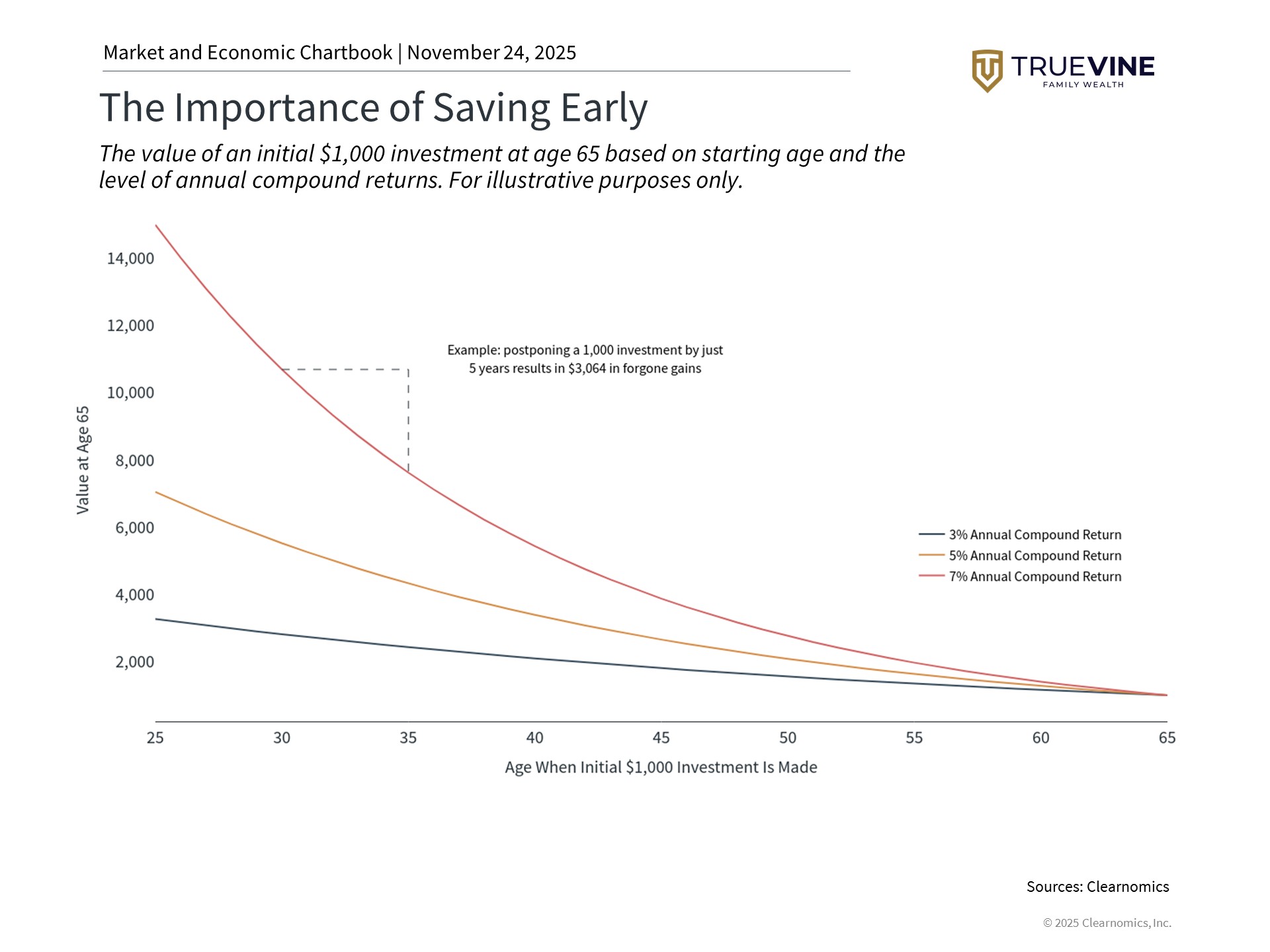
An old saying reminds us that “the best time to plant a tree was 20 years ago. The second best time is now.” This wisdom applies because extended market participation stands as one of the most effective mechanisms for building wealth, driven by the phenomenon of compounding returns. As investment gains are reinvested, they produce additional gains, creating an exponential effect that transforms modest savings into substantial wealth across multiple decades.
To illustrate, the included chart demonstrates how delaying your start by just a few years can produce meaningful consequences. An investor earning 7% average returns who begins at age 35 instead of 30 will see their initial $1,000 investment reach $7,612 rather than $10,677 by retirement. This relationship holds true whether average returns are 3%, 5%, or 10%. Throughout an investing career, these disparities accumulate and can become quite substantial. Even modest regular contributions can expand considerably over time through compounding.
What sometimes holds people back from investing is anxiety about market volatility, particularly when markets are trading near record levels. Yet the reason patient investors are compensated over time is precisely because maintaining discipline proves challenging. When market participants exit positions due to near-term worries, they generate opportunities for steadfast investors to acquire assets at more favorable valuations, establishing conditions for enhanced future performance. This explains why maintaining composure and investing consistently over extended timeframes represent the most reliable paths to reaching financial objectives.
As a Southwest Florida financial advisor, I encourage you to be intentional when setting your financial goals for 2026 by focusing on clarity, strategy, and long-term impact. A trusted Naples Florida financial advisor can help you evaluate your current financial plan, identify growth opportunities, and align your wealth goals with your values. Starting now creates momentum toward lasting financial security and a meaningful legacy.
Make it a priority to evaluate your retirement savings accounts

The structure of retirement benefits has undergone substantial evolution over recent decades, marked by a pronounced transition from traditional pension programs to “defined contribution” arrangements. Previously, most employers provided “defined benefit” plans, which guaranteed workers predetermined payment amounts during retirement. Currently, defined contribution vehicles such as 401(k) and 403(b) plans dominate the landscape, as illustrated in the included chart.
This evolution has fundamentally altered individual responsibilities regarding retirement preparation. The obligation now rests with workers themselves to establish appropriate plans for comfortable retirements. People must navigate decisions concerning account selection, tax optimization, contribution levels, investment choices, and withdrawal approaches.
Key factors to enhance your retirement planning in 2026 encompass determining which account types best suit your situation, assessing eligibility for employer matching contributions, identifying optimal investment types for each account to enhance tax efficiency, and additional considerations. For instance, holding taxable bonds within tax-advantaged accounts often proves beneficial since interest income typically faces taxation as ordinary income.
Although the movement toward defined contribution plans assigns retirement funding responsibility to individuals, it simultaneously creates opportunities for personalized financial planning. The future trajectory of programs like Social Security and Medicare remains uncertain. Therefore, gaining knowledge about the optimal approach for your circumstances becomes essential, preferably with guidance from a qualified advisor.
Commit to accounting for the possibility of an extended retirement period
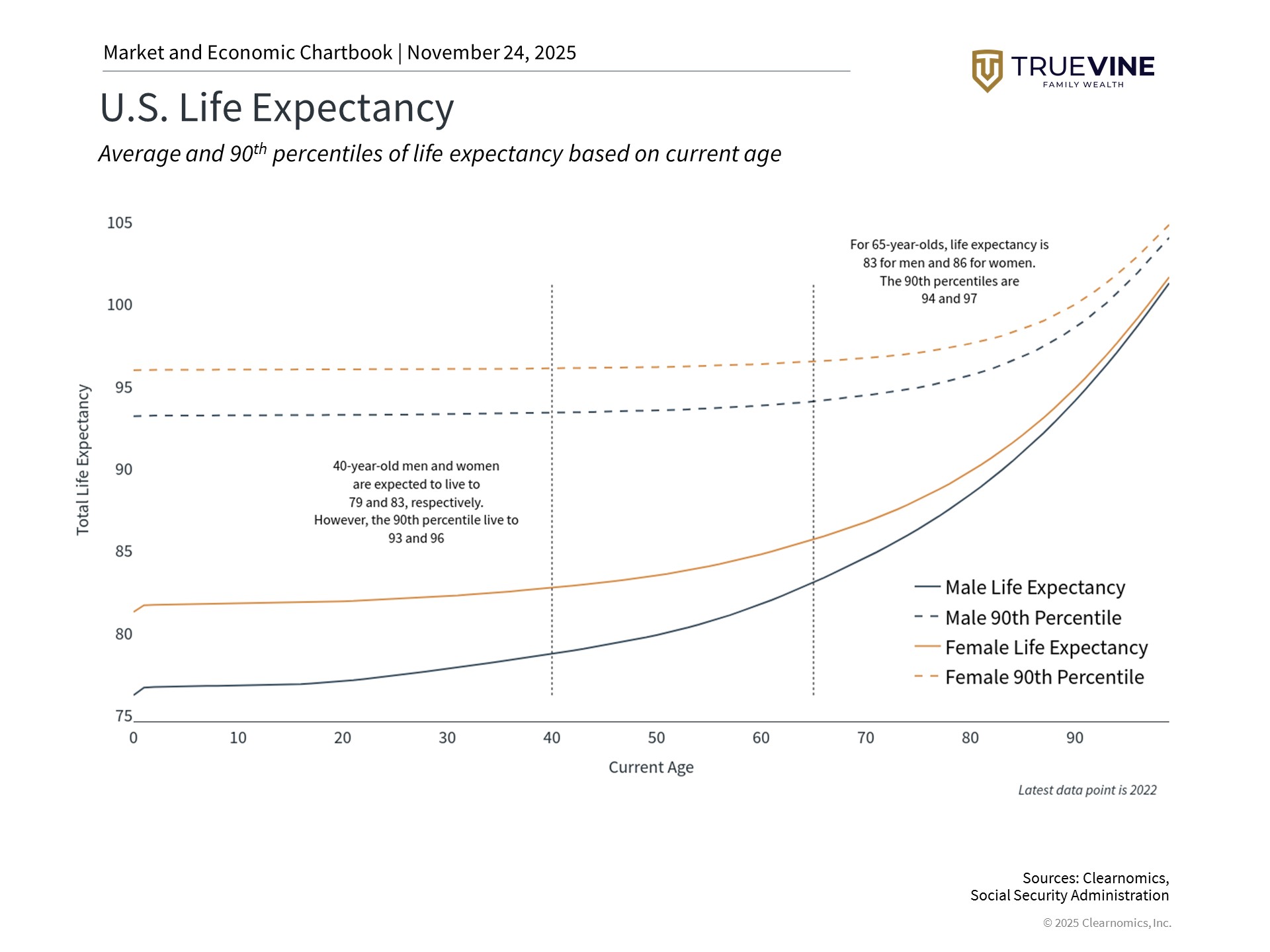
Rising life expectancies represent an unequivocally favorable development. However, the most significant financial challenge facing retirees may be the possibility of depleting their resources, commonly termed “longevity risk.” Managing longevity risk aims to enable retirees to experience fulfilling retirements free from financial anxiety.
Currently, accumulated savings must endure longer and produce greater income compared to previous generations. For numerous individuals, increased longevity could translate to retirement periods spanning 30 years or beyond. Equally important, these funds must continue appreciating to sustain increasingly lengthy retirements, particularly during periods of rising prices.
The provided chart indicates that, based on Social Security Administration data, today’s 40-year-old men and women can expect to reach ages 79 and 83 on average, respectively. Nevertheless, one in ten may survive to ages 93 and 96, or beyond. For individuals already aged 65, projected lifespans extend even further. These population trends suggest that planning for retirement lasting only until age 80 proves insufficient for many – it may continue for multiple decades thereafter.
Considerations such as medical expenses, inflation, and appropriate withdrawal rates gain heightened importance when preparing for prolonged retirements. Clearly, recognizing and addressing longevity risk proves essential for preserving financial well-being. By incorporating financial wellness alongside other health and lifestyle aspirations, you can adequately fund an extended retirement and maintain peace of mind regarding your finances.

The bottom line? The beginning of the year offers an excellent moment to establish financial resolutions. Beginning to save promptly, assessing retirement accounts regularly, and confirming your portfolio generates sufficient income and appreciation all prove vital for accomplishing long-term financial aspirations.
This blog is published by TrueVine Family Wealth. The firm is registered as an investment adviser with the state of Florida and only conducts business in states where it is properly registered or is excluded from registration requirements. Registration is not an endorsement of the firm by securities regulators and does not mean the adviser has achieved a specific level of skill or ability. The firm is not engaged in the practice of law or accounting.
Information presented is believed to be factual and up-to-date, but we do not guarantee its accuracy and it should not be regarded as a complete analysis of any subjects discussed. All expressions of opinion reflect the judgment of the authors on the date of the post and are subject to change. Blog posts were prepared by Clearnomics, a third-party content provider.
You should consult with a professional advisor before implementing any strategies discussed. Content should not be viewed as an offer to buy or sell any of the securities mentioned or as legal or tax advice. You should always consult an attorney or tax professional regarding your specific legal or tax situation. Estate planning rules and regulations are subject to change at any time.
All investments have the potential for profit or loss. Different types of investments and strategies involve higher and lower levels of risk. There is no guarantee that a specific investment or strategy will be suitable or profitable for an investor’s portfolio. Asset allocation, rebalancing, and diversification will not necessarily improve a client’s returns and cannot eliminate the risk of investment losses.
Historical performance returns for investment indexes and/or categories, usually do not deduct transaction and/or custodial charges or an advisory fee, which would decrease historical performance results. There are no guarantees that an investor’s portfolio will match or outperform a specific benchmark. Historical returns do not represent the performance of TrueVine or any of its advisory clients.
Copyright (c) 2025 Clearnomics, Inc. All rights reserved. The information contained herein has been obtained from sources believed to be reliable, but is not necessarily complete and its accuracy cannot be guaranteed. No representation or warranty, express or implied, is made as to the fairness, accuracy, completeness, or correctness of the information and opinions contained herein. The views and the other information provided are subject to change without notice. All reports posted on or via www.clearnomics.com or any affiliated websites, applications, or services are issued without regard to the specific investment objectives, financial situation, or particular needs of any specific recipient and are not to be construed as a solicitation or an offer to buy or sell any securities or related financial instruments. Past performance is not necessarily a guide to future results. Company fundamentals and earnings may be mentioned occasionally, but should not be construed as a recommendation to buy, sell, or hold the company’s stock. Predictions, forecasts, and estimates for any and all markets should not be construed as recommendations to buy, sell, or hold any security–including mutual funds, futures contracts, and exchange traded funds, or any similar instruments. The text, images, and other materials contained or displayed in this report are proprietary to Clearnomics, Inc. and constitute valuable intellectual property. All unauthorized reproduction or other use of material from Clearnomics, Inc. shall be deemed willful infringement(s) of this copyright and other proprietary and intellectual property rights, including but not limited to, rights of privacy. Clearnomics, Inc. expressly reserves all rights in connection with its intellectual property, including without limitation the right to block the transfer of its products and services and/or to track usage thereof, through electronic tracking technology, and all other lawful means, now known or hereafter devised. Clearnomics, Inc. reserves the right, without further notice, to pursue to the fullest extent allowed by the law any and all criminal and civil remedies for the violation of its rights.