
Understanding Economic Cycles and Their Role in Financial Strategy


In financial planning, distinguishing between what we can influence and what remains beyond our reach proves crucial. Our behavior, strategic planning decisions, and portfolio adjustments fall within our sphere of influence. Economic fluctuations, market dynamics, and policy changes, however, operate independently of our control. This understanding enables us to concentrate our efforts where they can make a meaningful difference.
As concerns about potential economic downturns mount and market volatility increases, revisiting the core principles of economic cycles and their implications for financial strategy becomes particularly valuable.
Understanding Economic Cycles
Economic cycles encompass the economy’s natural progression through expansion and contraction phases, tracked through indicators such as GDP, employment levels, and industrial output. These cycles typically span extended periods, averaging 5-10 years, though their duration can fluctuate considerably.
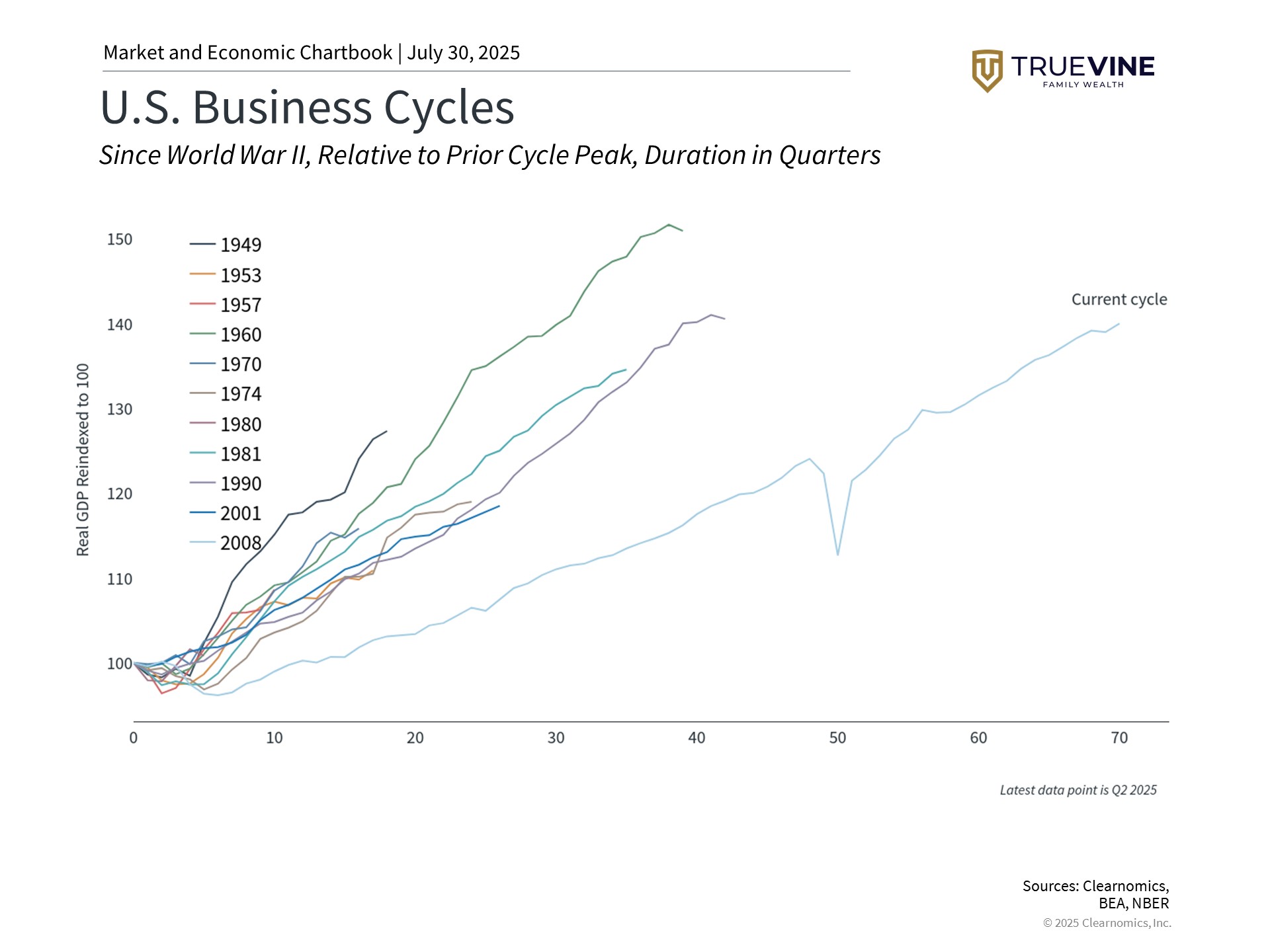
The National Bureau of Economic Research documents twelve recessions following World War II. The past quarter-century witnessed three notable downturns: the pandemic-induced recession of 2020, the 2008 financial crisis, and the 2001 technology sector collapse. Beyond these actual recessions, numerous instances occurred when market participants and analysts anticipated economic contractions that never materialized.
Economic cycles have extended in length since the inflationary challenges of the 1970s and early 1980s ended. The sustained expansion lasting until 2008 earned recognition as “The Great Moderation” – characterized by robust economic performance, controlled inflation, minimal unemployment, and cycle durations averaging nearly nine years.
Economic Cycle Phases
Though every economic cycle presents unique characteristics, certain patterns consistently emerge. Generally, these cycles progress through four identifiable stages:
- Expansion – Economic activity increases, unemployment decreases, consumer sentiment improves, and business operations intensify. GDP registers positive growth as companies invest in expanding their capabilities.
- Peak – Growth reaches its zenith with the economy functioning at or near maximum capacity. Inflation pressures may emerge alongside signs of economic overextension.
- Contraction – Economic momentum slows, employment opportunities diminish, and GDP growth decelerates or turns negative. Consumer expenditure typically contracts during this period.
- Trough – The cycle’s lowest point where decline stabilizes before recovery begins. Unemployment peaks while business confidence reaches minimal levels.
Phase durations vary significantly, with some cycles persisting longer than anticipated while others conclude unexpectedly.
The 1990s cycle exemplifies extended duration when economic deceleration in 1995 failed to trigger recession. Federal Reserve intervention achieved a “soft landing” by reducing inflation without hampering growth.
Conversely, the 2008 financial crisis demonstrated rapid deterioration following sector-wide collapse. Similarly, 2020’s economic shutdown caused immediate activity reduction.
Precisely forecasting cycle timing remains exceptionally challenging. Economics’ reputation as “the dismal science” stems partly from its limited success in recession prediction and tendency toward false alarms. Nevertheless, understanding our general position within these cycles enhances financial decision-making capabilities.
Separating Economic And Market Cycles
Market fluctuations demonstrate greater volatility and frequency compared to economic cycles. Stock markets may experience numerous corrections during single economic cycles, including regular short-term declines annually, driven by investor psychology, liquidity factors, and elements beyond pure economic fundamentals.

Market fluctuations demonstrate greater volatility and frequency compared to economic cycles. Stock markets may experience numerous corrections during single economic cycles, including regular short-term declines annually, driven by investor psychology, liquidity factors, and elements beyond pure economic fundamentals.
This divergence occurs because markets focus on future prospects while economic indicators reflect historical performance. Though economic data influences market behavior, headlines, sentiment, and diverse information sources also shape investor decisions. Consequently, markets frequently overreact to temporary developments.
Navigating Cycles Through Financial Planning
Instead of attempting market timing, these strategies prove more effective. The objective involves maintaining progress toward financial objectives throughout economic and market fluctuations:
- Embrace long-term thinking – Brief market disruptions often become negligible when examined across decades. They may provide misleading economic cycle signals. The 2022 market decline, for instance, failed to predict actual economic deterioration.
- Regular portfolio rebalancing – Systematic rebalancing implements “buy low and sell high” discipline by reducing appreciated holdings while increasing underperforming positions. This methodical approach helps navigate market cycles while avoiding emotional responses.
- Cycle-appropriate expectations – Late-cycle periods featuring elevated valuations may generate reduced future returns. Consider tempering return expectations during such phases rather than pursuing higher yields through excessive risk exposure.
- Emergency fund maintenance – Financial strategies should acknowledge inevitable downturns. Emergency reserves covering 6-12 months of expenses provide essential flexibility during contractionary periods, especially when employment stability becomes uncertain.
Building Portfolio Durability Across Economic Phases
Appropriate portfolio construction remains fundamental for investing throughout economic cycles. Various asset categories respond differently to evolving economic environments. Equities generally prosper during expansions but face challenges during contractions. Bonds can generate income during growth phases while providing portfolio stability during downturns.
Optimal portfolio composition varies by individual, balancing asset classes according to investment timeframe, risk capacity, and financial objectives. Well-diversified portfolios may trail the strongest-performing asset category during specific cycles, yet they avoid severe declines that could compromise financial plans.
The bottom line? Economic and market cycles constitute inherent aspects of the investment journey. Instead of attempting to forecast every transition point, historical evidence supports maintaining well-structured portfolios capable of enduring all cycle phases.

This blog is published by TrueVine Family Wealth. The firm is registered as an investment adviser with the state of Florida and only conducts business in states where it is properly registered or is excluded from registration requirements. Registration is not an endorsement of the firm by securities regulators and does not mean the adviser has achieved a specific level of skill or ability. The firm is not engaged in the practice of law or accounting.
Information presented is believed to be factual and up-to-date, but we do not guarantee its accuracy and it should not be regarded as a complete analysis of any subjects discussed. All expressions of opinion reflect the judgment of the authors on the date of the post and are subject to change. Blog posts were prepared by Clearnomics, a third-party content provider.
You should consult with a professional advisor before implementing any strategies discussed. Content should not be viewed as an offer to buy or sell any of the securities mentioned or as legal or tax advice. You should always consult an attorney or tax professional regarding your specific legal or tax situation. Estate planning rules and regulations are subject to change at any time.
All investments have the potential for profit or loss. Different types of investments and strategies involve higher and lower levels of risk. There is no guarantee that a specific investment or strategy will be suitable or profitable for an investor’s portfolio. Asset allocation, rebalancing, and diversification will not necessarily improve a client’s returns and cannot eliminate the risk of investment losses.
Historical performance returns for investment indexes and/or categories, usually do not deduct transaction and/or custodial charges or an advisory fee, which would decrease historical performance results. There are no guarantees that an investor’s portfolio will match or outperform a specific benchmark. Historical returns do not represent the performance of TrueVine or any of its advisory clients.
Copyright (c) 2025 Clearnomics, Inc. All rights reserved. The information contained herein has been obtained from sources believed to be reliable, but is not necessarily complete and its accuracy cannot be guaranteed. No representation or warranty, express or implied, is made as to the fairness, accuracy, completeness, or correctness of the information and opinions contained herein. The views and the other information provided are subject to change without notice. All reports posted on or via www.clearnomics.com or any affiliated websites, applications, or services are issued without regard to the specific investment objectives, financial situation, or particular needs of any specific recipient and are not to be construed as a solicitation or an offer to buy or sell any securities or related financial instruments. Past performance is not necessarily a guide to future results. Company fundamentals and earnings may be mentioned occasionally, but should not be construed as a recommendation to buy, sell, or hold the company’s stock. Predictions, forecasts, and estimates for any and all markets should not be construed as recommendations to buy, sell, or hold any security–including mutual funds, futures contracts, and exchange traded funds, or any similar instruments. The text, images, and other materials contained or displayed in this report are proprietary to Clearnomics, Inc. and constitute valuable intellectual property. All unauthorized reproduction or other use of material from Clearnomics, Inc. shall be deemed willful infringement(s) of this copyright and other proprietary and intellectual property rights, including but not limited to, rights of privacy. Clearnomics, Inc. expressly reserves all rights in connection with its intellectual property, including without limitation the right to block the transfer of its products and services and/or to track usage thereof, through electronic tracking technology, and all other lawful means, now known or hereafter devised. Clearnomics, Inc. reserves the right, without further notice, to pursue to the fullest extent allowed by the law any and all criminal and civil remedies for the violation of its rights.