
How Military Conflict Affects Markets and What Long-Term Investors Should Know


As widely reported, the U.S. and Israel have launched military strikes against Iran, targeting its leadership, military assets, and nuclear infrastructure. Iran’s Supreme Leader has been confirmed killed, and Iran has responded with missile and drone attacks across the Middle East. President Trump has stated that the goal of the operation, called “Operation Epic Fury,” is regime change in Tehran, with strikes expected to continue for weeks and a number of U.S. troop casualties already reported.
The situation is changing quickly, and the safety of civilians and troops is the top priority. Still, investors naturally want to understand what this means for markets, oil prices, and their portfolios. History offers useful guidance: while specific events like this are impossible to predict, the fact that geopolitical crises happen regularly is not surprising. Well-structured portfolios are built to handle exactly this kind of uncertainty.
This Conflict Is Part Of A Longer Story
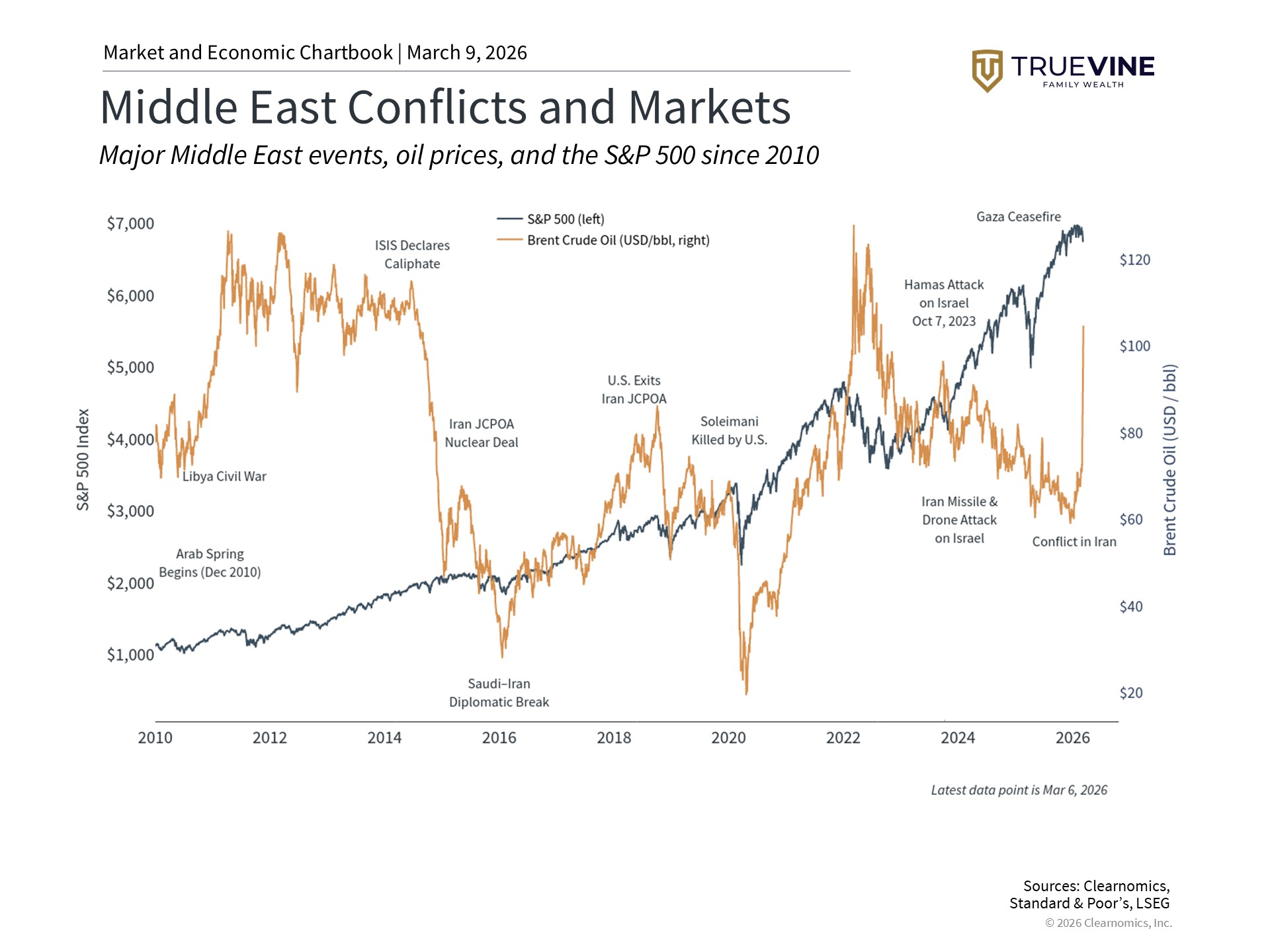
Tensions between the U.S., Israel, and Iran have been building for years. This latest escalation follows a monthlong U.S. military buildup in the region, failed nuclear negotiations, and earlier support for Iranian protesters. Key moments in this history include Iran’s 2019 drone strikes on Saudi oil infrastructure, the October 2023 Hamas attack on Israel, and last summer’s 12-day Israeli military campaign against Iran’s nuclear and missile programs. The current strikes, which include targeting Iran’s senior leadership, are broader in scope than past engagements — but history shows that such conflicts are not always a catalyst for lasting market moves.
What This Means For Oil Prices
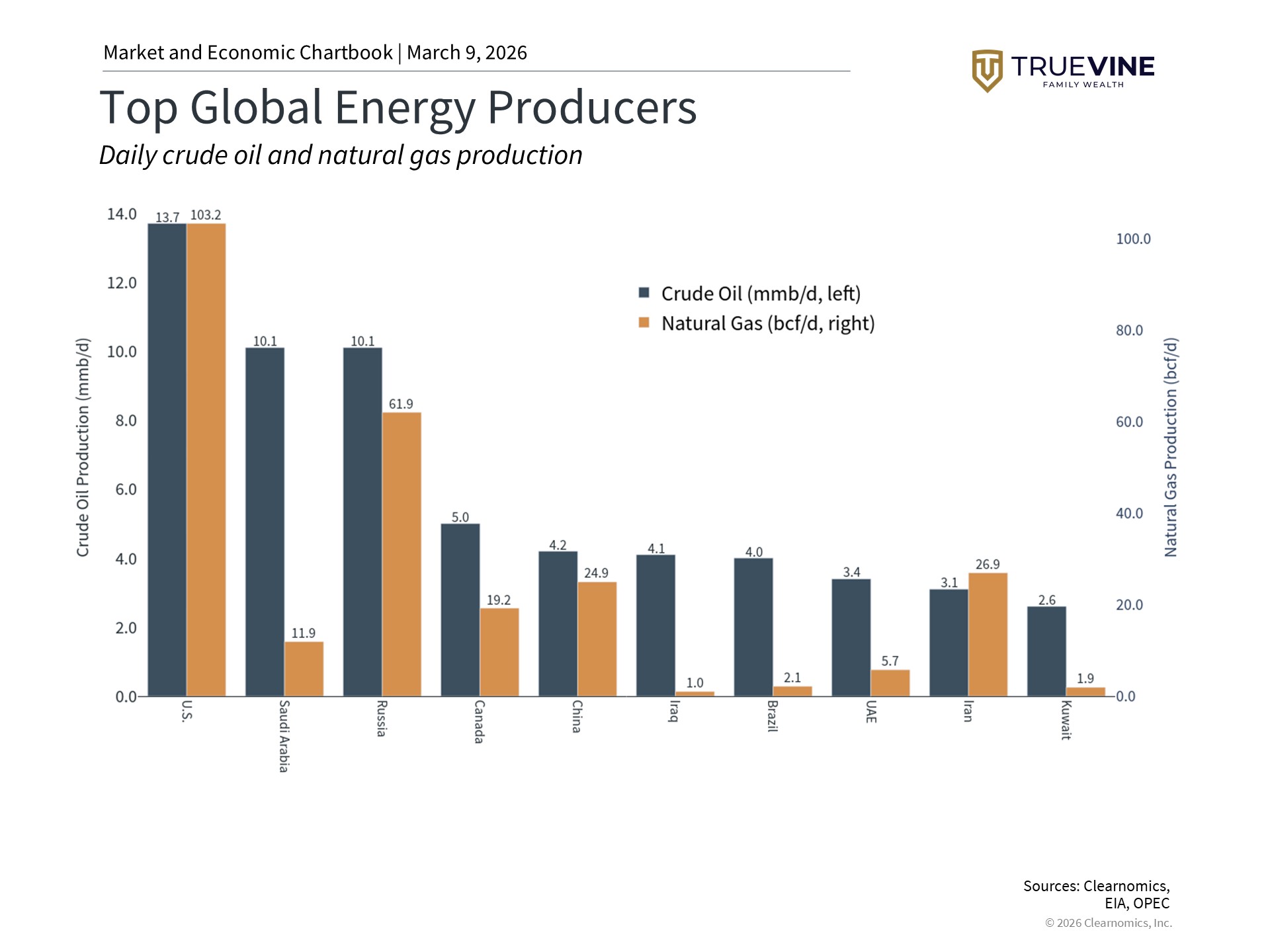
The most direct way Middle East conflicts affect financial markets is through energy prices. Iran produces around 3 million barrels of oil per day and sits along the Strait of Hormuz — the world’s most important energy shipping route. According to the U.S. Energy Information Administration, roughly one-third of all seaborne oil exports pass through this waterway. Oil prices have already risen in response to the strikes, with WTI crude moving to the low $70s and Brent crude just under $80 per barrel.
That said, today’s oil prices remain well below the nearly $128 per barrel peak seen in 2022 when Russia invaded Ukraine. The U.S. is now the world’s largest oil and natural gas producer, which helps cushion the domestic economy from global supply disruptions. Oil prices are also notoriously difficult to predict — after Russia’s invasion of Ukraine, many expected prices to stay high for a long time, but they fell much sooner than expected. A similar pattern was seen after the U.S. operation in Venezuela earlier this year.
Why Staying Invested Matters

For long-term investors, the most important lesson from past geopolitical events is the value of staying invested. It is natural to feel uneasy when headlines describe military strikes and the possibility of a wider war. However, markets have navigated serious global crises before — from World War II to the Gulf War to the conflicts in Iraq, Afghanistan, Ukraine, and the Middle East — and have generally recovered over time, driven by underlying economic fundamentals.
It is also worth noting that Iran plays almost no direct role in most investment portfolios. The country has been under heavy economic sanctions for years, and its economy has suffered from severe inflation and a collapsing currency. Very few investors have meaningful exposure to Iran in their portfolios. While markets may see some short-term volatility as events continue to unfold, trying to time these moves has historically been counterproductive. Missing just a few of the market’s best trading days can significantly reduce long-term returns.

This blog is published by TrueVine Family Wealth. The firm is registered as an investment adviser with the state of Florida and only conducts business in states where it is properly registered or is excluded from registration requirements. Registration is not an endorsement of the firm by securities regulators and does not mean the adviser has achieved a specific level of skill or ability. The firm is not engaged in the practice of law or accounting.
Information presented is believed to be factual and up-to-date, but we do not guarantee its accuracy and it should not be regarded as a complete analysis of any subjects discussed. All expressions of opinion reflect the judgment of the authors on the date of the post and are subject to change. Blog posts were prepared by Clearnomics, a third-party content provider.
You should consult with a professional advisor before implementing any strategies discussed. Content should not be viewed as an offer to buy or sell any of the securities mentioned or as legal or tax advice. You should always consult an attorney or tax professional regarding your specific legal or tax situation. Estate planning rules and regulations are subject to change at any time.
All investments have the potential for profit or loss. Different types of investments and strategies involve higher and lower levels of risk. There is no guarantee that a specific investment or strategy will be suitable or profitable for an investor’s portfolio. Asset allocation, rebalancing, and diversification will not necessarily improve a client’s returns and cannot eliminate the risk of investment losses.
Historical performance returns for investment indexes and/or categories, usually do not deduct transaction and/or custodial charges or an advisory fee, which would decrease historical performance results. There are no guarantees that an investor’s portfolio will match or outperform a specific benchmark. Historical returns do not represent the performance of TrueVine or any of its advisory clients.
Copyright (c) 2026 Clearnomics, Inc. All rights reserved. The information contained herein has been obtained from sources believed to be reliable, but is not necessarily complete and its accuracy cannot be guaranteed. No representation or warranty, express or implied, is made as to the fairness, accuracy, completeness, or correctness of the information and opinions contained herein. The views and the other information provided are subject to change without notice. All reports posted on or via www.clearnomics.com or any affiliated websites, applications, or services are issued without regard to the specific investment objectives, financial situation, or particular needs of any specific recipient and are not to be construed as a solicitation or an offer to buy or sell any securities or related financial instruments. Past performance is not necessarily a guide to future results. Company fundamentals and earnings may be mentioned occasionally, but should not be construed as a recommendation to buy, sell, or hold the company’s stock. Predictions, forecasts, and estimates for any and all markets should not be construed as recommendations to buy, sell, or hold any security–including mutual funds, futures contracts, and exchange traded funds, or any similar instruments. The text, images, and other materials contained or displayed in this report are proprietary to Clearnomics, Inc. and constitute valuable intellectual property. All unauthorized reproduction or other use of material from Clearnomics, Inc. shall be deemed willful infringement(s) of this copyright and other proprietary and intellectual property rights, including but not limited to, rights of privacy. Clearnomics, Inc. expressly reserves all rights in connection with its intellectual property, including without limitation the right to block the transfer of its products and services and/or to track usage thereof, through electronic tracking technology, and all other lawful means, now known or hereafter devised. Clearnomics, Inc. reserves the right, without further notice, to pursue to the fullest extent allowed by the law any and all criminal and civil remedies for the violation of its rights.