
How $100 Oil and Middle East Tensions Are Impacting Your Investments

Fighting in Iran and the near-shutdown of the Strait of Hormuz have sent oil prices sharply higher. Both major oil price benchmarks have jumped from around $70 per barrel to around $100 in just a few days — levels not seen since Russia invaded Ukraine in 2022. This has created significant uncertainty in global markets, with talk of a “global economic downturn” and “stagflation” (a combination of slow growth and rising prices) making headlines.
While the safety of civilians and troops is the most pressing concern, investors can take comfort from history. Oil price spikes driven by geopolitical events have happened before — roughly every decade — and markets have consistently recovered over time. So what should investors keep in mind right now?
Why Oil Has Climbed To $100
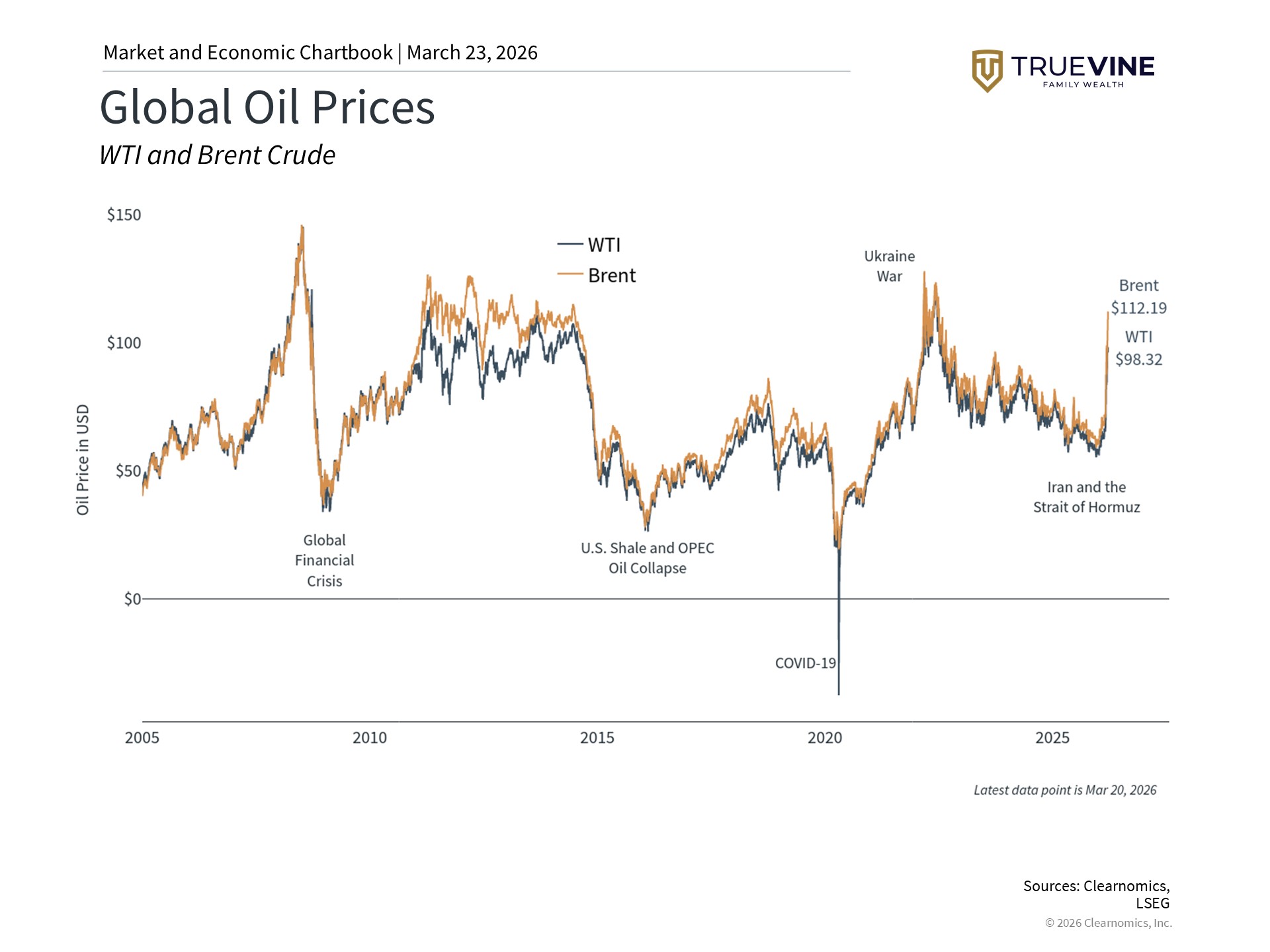
The key flashpoint is the Strait of Hormuz, a narrow waterway through which roughly 20% of the world’s oil and a large share of natural gas travel each year. Attacks on tankers and safety fears have effectively halted traffic, forcing major oil-producing countries like Saudi Arabia, Iraq, Kuwait, Qatar, and the UAE to store oil rather than ship it. As storage fills up, those countries have been forced to cut production — not by choice, but by necessity. This chain reaction is why prices have risen so quickly.
For context, when Russia invaded Ukraine in early 2022, Brent crude surged to nearly $128 per barrel and average U.S. gasoline prices topped $5 per gallon. In each past episode, prices eventually came back down as supply and demand adjusted. History suggests this pattern is likely to repeat.
A Christian financial advisor in Southwest Florida can help you approach market uncertainty with a long-term perspective grounded in stewardship, focusing on prudent decision-making rather than emotional responses.
How Higher Oil Prices Affect Consumers And Businesses

The most direct impact for everyday people is at the gas pump. Gasoline prices have risen back toward $3.50 per gallon nationally and could go higher — though this is still well below the $5 per gallon seen four years ago. Beyond gasoline, higher energy costs raise the price of shipping goods, making products more expensive across the board. Economists call this “cost-push inflation” — when rising production costs get passed on to consumers.
The good news is that the U.S. is better positioned than in past oil crises. As the world’s largest producer of oil and natural gas, the U.S. has a level of energy independence it didn’t have in earlier decades. Economists and investors also tend to view supply-driven price shocks as “transitory,” meaning their effects fade over time as the situation stabilizes or the economy adapts.
Working with a Christian financial advisor in Naples, Florida provides an opportunity to integrate faith-based values into financial decisions while navigating periods of market volatility with discipline and clarity.
Markets Can Weather Higher Oil Prices
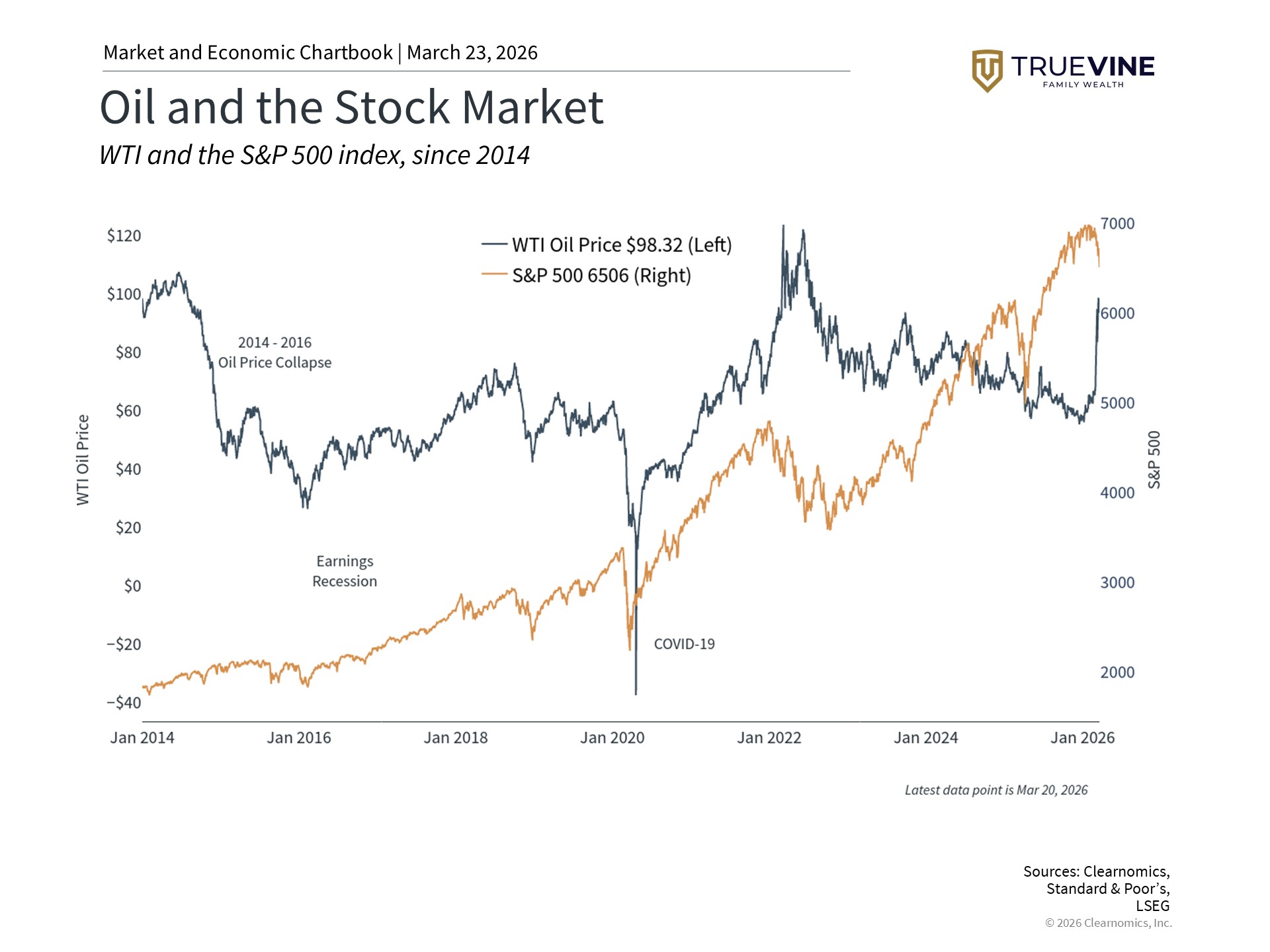
Financial markets have reacted to the news, but the broader picture is more reassuring than headlines suggest. While some international indexes have seen notable short-term declines, many are still up significantly over the past year. Meanwhile, energy stocks have gained about 25% year-to- date, and commodities (a category that includes oil, gas, and precious metals) are up over 20% this year. This is a good reminder of why holding a mix of different investments — known as diversification — can help protect a portfolio during uncertain times.
There is also some uncertainty about what the Federal Reserve (the U.S. central bank) may do with interest rates. If oil-driven inflation rises, the Fed might hold rates higher for longer. Markets currently expect at least one rate cut in September 2026. However, if the supply disruption turns out to be temporary, its effect on interest rate decisions may be limited — as has been the case in past episodes.

This blog is published by TrueVine Family Wealth. The firm is registered as an investment adviser with the state of Florida and only conducts business in states where it is properly registered or is excluded from registration requirements. Registration is not an endorsement of the firm by securities regulators and does not mean the adviser has achieved a specific level of skill or ability. The firm is not engaged in the practice of law or accounting.
Information presented is believed to be factual and up-to-date, but we do not guarantee its accuracy and it should not be regarded as a complete analysis of any subjects discussed. All expressions of opinion reflect the judgment of the authors on the date of the post and are subject to change. Blog posts were prepared by Clearnomics, a third-party content provider.
You should consult with a professional advisor before implementing any strategies discussed. Content should not be viewed as an offer to buy or sell any of the securities mentioned or as legal or tax advice. You should always consult an attorney or tax professional regarding your specific legal or tax situation. Estate planning rules and regulations are subject to change at any time.
All investments have the potential for profit or loss. Different types of investments and strategies involve higher and lower levels of risk. There is no guarantee that a specific investment or strategy will be suitable or profitable for an investor’s portfolio. Asset allocation, rebalancing, and diversification will not necessarily improve a client’s returns and cannot eliminate the risk of investment losses.
Historical performance returns for investment indexes and/or categories, usually do not deduct transaction and/or custodial charges or an advisory fee, which would decrease historical performance results. There are no guarantees that an investor’s portfolio will match or outperform a specific benchmark. Historical returns do not represent the performance of TrueVine or any of its advisory clients.
Copyright (c) 2026 Clearnomics, Inc. All rights reserved. The information contained herein has been obtained from sources believed to be reliable, but is not necessarily complete and its accuracy cannot be guaranteed. No representation or warranty, express or implied, is made as to the fairness, accuracy, completeness, or correctness of the information and opinions contained herein. The views and the other information provided are subject to change without notice. All reports posted on or via www.clearnomics.com or any affiliated websites, applications, or services are issued without regard to the specific investment objectives, financial situation, or particular needs of any specific recipient and are not to be construed as a solicitation or an offer to buy or sell any securities or related financial instruments. Past performance is not necessarily a guide to future results. Company fundamentals and earnings may be mentioned occasionally, but should not be construed as a recommendation to buy, sell, or hold the company's stock. Predictions, forecasts, and estimates for any and all markets should not be construed as recommendations to buy, sell, or hold any security–including mutual funds, futures contracts, and exchange traded funds, or any similar instruments. The text, images, and other materials contained or displayed in this report are proprietary to Clearnomics, Inc. and constitute valuable intellectual property. All unauthorized reproduction or other use of material from Clearnomics, Inc. shall be deemed willful infringement(s) of this copyright and other proprietary and intellectual property rights, including but not limited to, rights of privacy. Clearnomics, Inc. expressly reserves all rights in connection with its intellectual property, including without limitation the right to block the transfer of its products and services and/or to track usage thereof, through electronic tracking technology, and all other lawful means, now known or hereafter devised. Clearnomics, Inc. reserves the right, without further notice, to pursue to the fullest extent allowed by the law any and all criminal and civil remedies for the violation of its rights.