
How to Set Realistic Investment Goals Using Behavioral Finance


The stock market has done well over the past few years, which is good news for investors and their financial plans. However, this recent success can sometimes create unrealistic expectations about what to expect in the future. It’s important to remember that investing happens during all types of market conditions – both when markets are doing well and when they’re struggling. While taking advantage of opportunities and managing risk matter, it’s equally important to set realistic expectations based on historical patterns, careful analysis, and personalized financial plans.
Behavioral finance is the area of study that looks at how people react emotionally and mentally when making investment decisions. More than 50 years of research shows that people can fall into mental traps and emotional patterns that often lead to poor investment decisions. Most investors know that we can’t control how markets move, how the economy performs, or what policy decisions lawmakers make. But we can control how we respond to news and events.
TrueVine Family Wealth wants to help guide you as you make decisions with Faith-Based Wealth Management. We serve as your personal CFO – offering clarity, coordination, and the opportunity to achieve peace of mind as you steward your finances. Our team at TrueVine Family Wealth offer Southwest Florida residents comprehensive financial planning.
Learning about these mental traps isn’t just an academic topic – it’s a useful skill for making better choices. The truth is that everyone faces these biases, and they have nothing to do with how smart or educated we are. What makes successful long-term investors different isn’t that they completely avoid these biases. Instead, they follow systems and strategies that help them make good decisions even when facing these challenges.
Look At The Full Picture, Not Just What Happened Recently
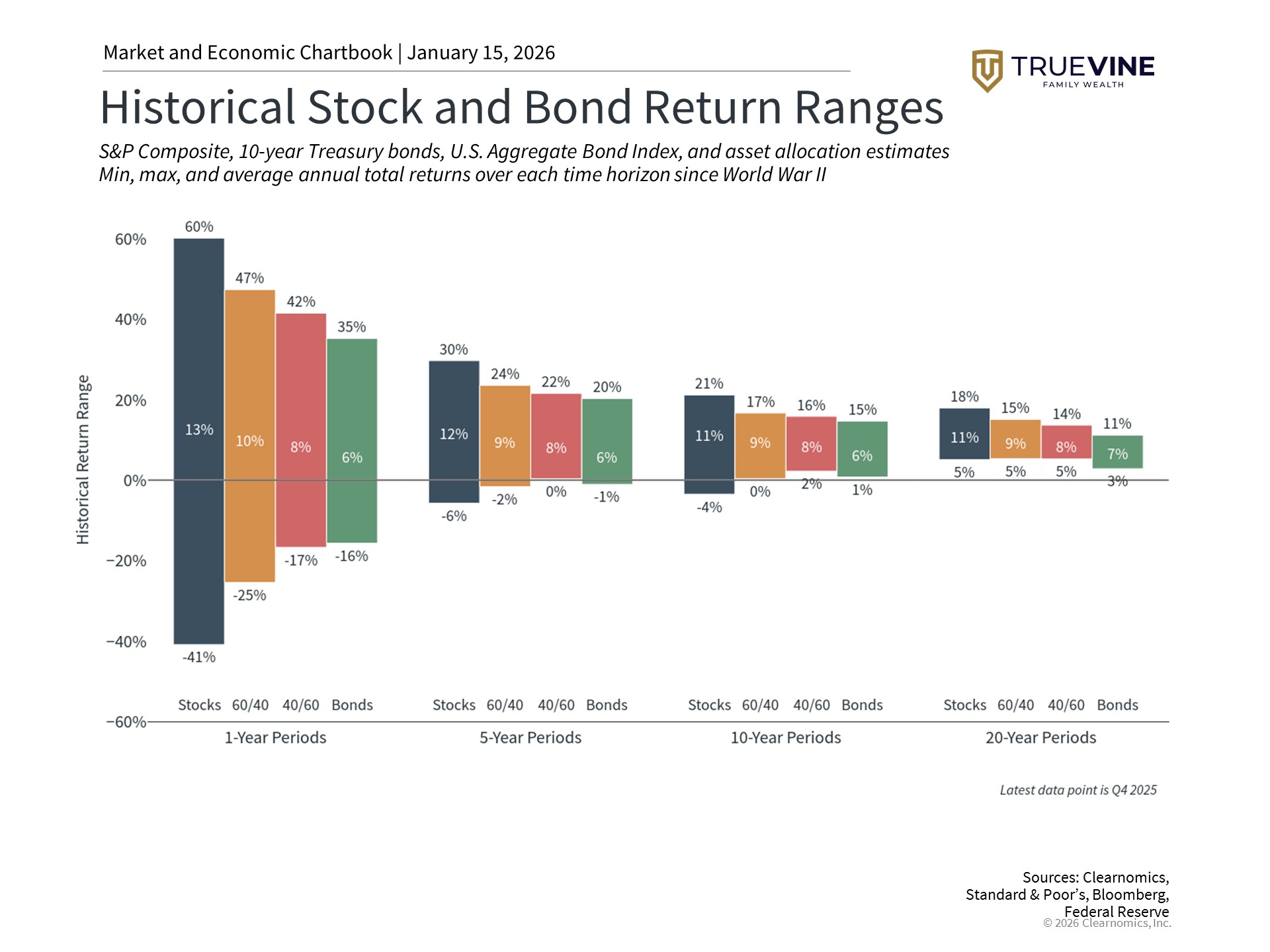
First, it’s normal for investors to make decisions based on recent news and events, since that’s what we see most often. This is called recency bias, which becomes a problem when we focus too much on recent events and ignore long-term facts. In other words, it’s thinking that “this time is different” based on just a few recent examples.
The S&P 500 (a measure of 500 large U.S. companies) had double-digit returns in six of the past seven years. It’s easy for investors to start thinking this is normal instead of unusually good. This can lead to two problems: either thinking this trend will continue forever, or believing that a market drop is “overdue” just because markets have been doing well.
History tells us the situation is more complex. The chart shows that while the S&P 500 has averaged more than 10% returns per year over the long run, individual years can be very different. The recent string of strong years has happened before in market history, but it doesn’t guarantee what will happen next. Instead of trying to predict what will happen based only on the past few years, long-term investing is about benefiting from the overall positive pattern over time.
What makes recency bias especially tricky today is how it combines with another bias called “herd mentality.” When markets are rising, the fear of missing out can push investors to abandon their well-thought-out plans. They might invest more in stocks than is appropriate for their situation, chase trendy sectors like artificial intelligence and technology, or take on too much risk. History shows that investor emotions change over time, so the key is not to get swept up in any particular trend.
The answer to these biases isn’t to ignore recent performance. Instead, view it within the proper historical context. Strong returns are positive and should prompt investors to review their portfolios to make sure their investments still match their long-term goals.
View Gains And Losses Based On Facts, Not Emotions
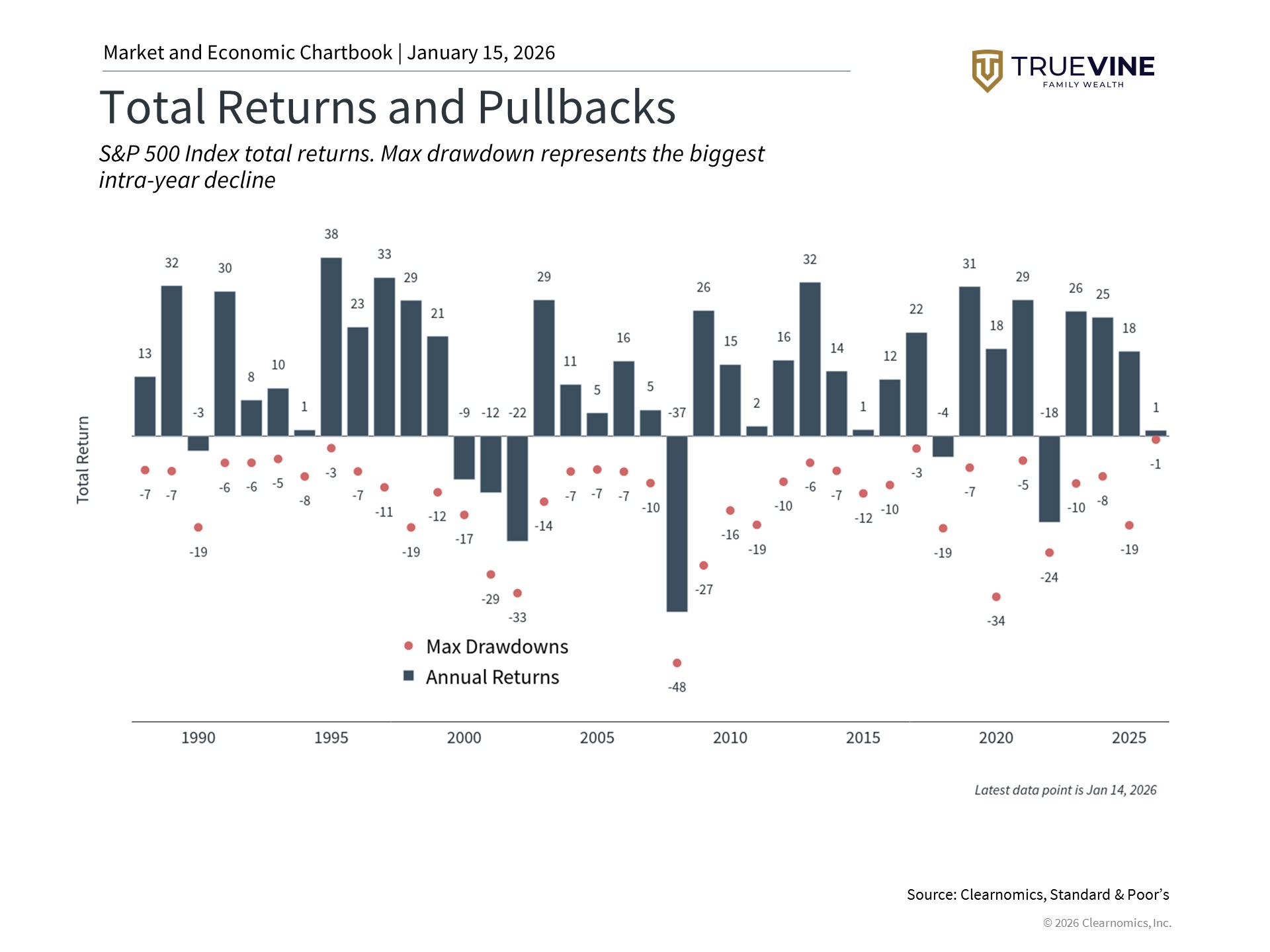
Another bias that matters today is the idea that investors don’t experience investment gains and losses in a logical way. The long history of the stock market makes this clear. When looking at the S&P 500 over many decades, stock market drops happen from time to time but are less important than the long-term upward trend. Yet in the moment, these declines can trigger strong emotional reactions.
Daniel Kahneman and Amos Tversky, two psychologists whose research forms the foundation of behavioral science, wrote that “losses loom larger than gains.” This describes a concept called loss aversion, which means that people tend to feel the pain of losses more strongly than the happiness of similar gains. For example, imagine winning $100 and how excited you might feel. Now, compare that to losing $100 of your hard-earned money and how that might affect your mood. For many people, the feeling of loss is what stays with them and influences future decisions.
This matters because reaching financial goals requires staying invested and disciplined through both good and bad times. The chart above shows that even though the stock market has gone up in two-thirds of years, it often experiences significant drops during the year. Last year’s tariff-driven volatility (market ups and downs) is a perfect example. Those who sold their investments too soon, or near the market low point, would have missed the recovery that pushed markets to new all-time highs.
Consider Opportunities Across Different Types Of Investments And Global Regions

In today’s market, the concept of home bias has become increasingly important. This means that investors tend to invest in what they know based on where they live. One version of this, called home country bias, is the tendency to invest too heavily in domestic investments even when other regions might offer good opportunities.
Over the past decade, U.S. stocks have delivered strong returns compared to developed and emerging markets (stocks in other countries), driven by technology sector strength and strong company profits. However, this isn’t always the case. In 2025, the MSCI EAFE index (a measure of developed market stocks outside the U.S.) and the MSCI EM index (a measure of emerging market stocks) both performed better than U.S. stocks. While there’s no guarantee this pattern will continue, it highlights the importance of investing across different types of investments and geographic regions.
History shows that market leadership changes over time and is hard to predict. As the chart above shows, international markets currently have lower valuations (they cost less relative to company earnings) than U.S. stocks, and can therefore help improve the risk-reward balance of portfolios. Ultimately, investing isn’t about maximizing returns in any single time period, but about creating more consistent outcomes over complete market cycles.
Our team in Southwest Florida is ready to answer any questions you may have about your financial planning and wealth management. Contact TrueVine Family Wealth today.

This blog is published by TrueVine Family Wealth. The firm is registered as an investment adviser with the state of Florida and only conducts business in states where it is properly registered or is excluded from registration requirements. Registration is not an endorsement of the firm by securities regulators and does not mean the adviser has achieved a specific level of skill or ability. The firm is not engaged in the practice of law or accounting.
Information presented is believed to be factual and up-to-date, but we do not guarantee its accuracy and it should not be regarded as a complete analysis of any subjects discussed. All expressions of opinion reflect the judgment of the authors on the date of the post and are subject to change. Blog posts were prepared by Clearnomics, a third-party content provider.
You should consult with a professional advisor before implementing any strategies discussed. Content should not be viewed as an offer to buy or sell any of the securities mentioned or as legal or tax advice. You should always consult an attorney or tax professional regarding your specific legal or tax situation. Estate planning rules and regulations are subject to change at any time.
All investments have the potential for profit or loss. Different types of investments and strategies involve higher and lower levels of risk. There is no guarantee that a specific investment or strategy will be suitable or profitable for an investor’s portfolio. Asset allocation, rebalancing, and diversification will not necessarily improve a client’s returns and cannot eliminate the risk of investment losses.
Historical performance returns for investment indexes and/or categories, usually do not deduct transaction and/or custodial charges or an advisory fee, which would decrease historical performance results. There are no guarantees that an investor’s portfolio will match or outperform a specific benchmark. Historical returns do not represent the performance of TrueVine or any of its advisory clients.