
How Jobs, Inflation, and Growth Signal the Economy’s Strength


The state of the economy matters to long-term investors because it shapes both their portfolios and financial plans. Recent data has sent mixed signals, leaving many investors uncertain about what to think.
Rather than focusing on a single number, it helps to look at the full picture. Just as a doctor checks blood pressure, heart rate, and other signs together, investors benefit from reviewing multiple indicators — like jobs, inflation, and economic growth — at once. Today’s key numbers are largely encouraging: growth is stronger than expected, inflation is slowing, and unemployment remains low. However, the labor market tells a more nuanced story, and understanding how all these pieces fit together is more valuable than reacting to any one report.
The Labor Market Is At A Turning Point
Job openings and unemployed workers are now nearly balanced.
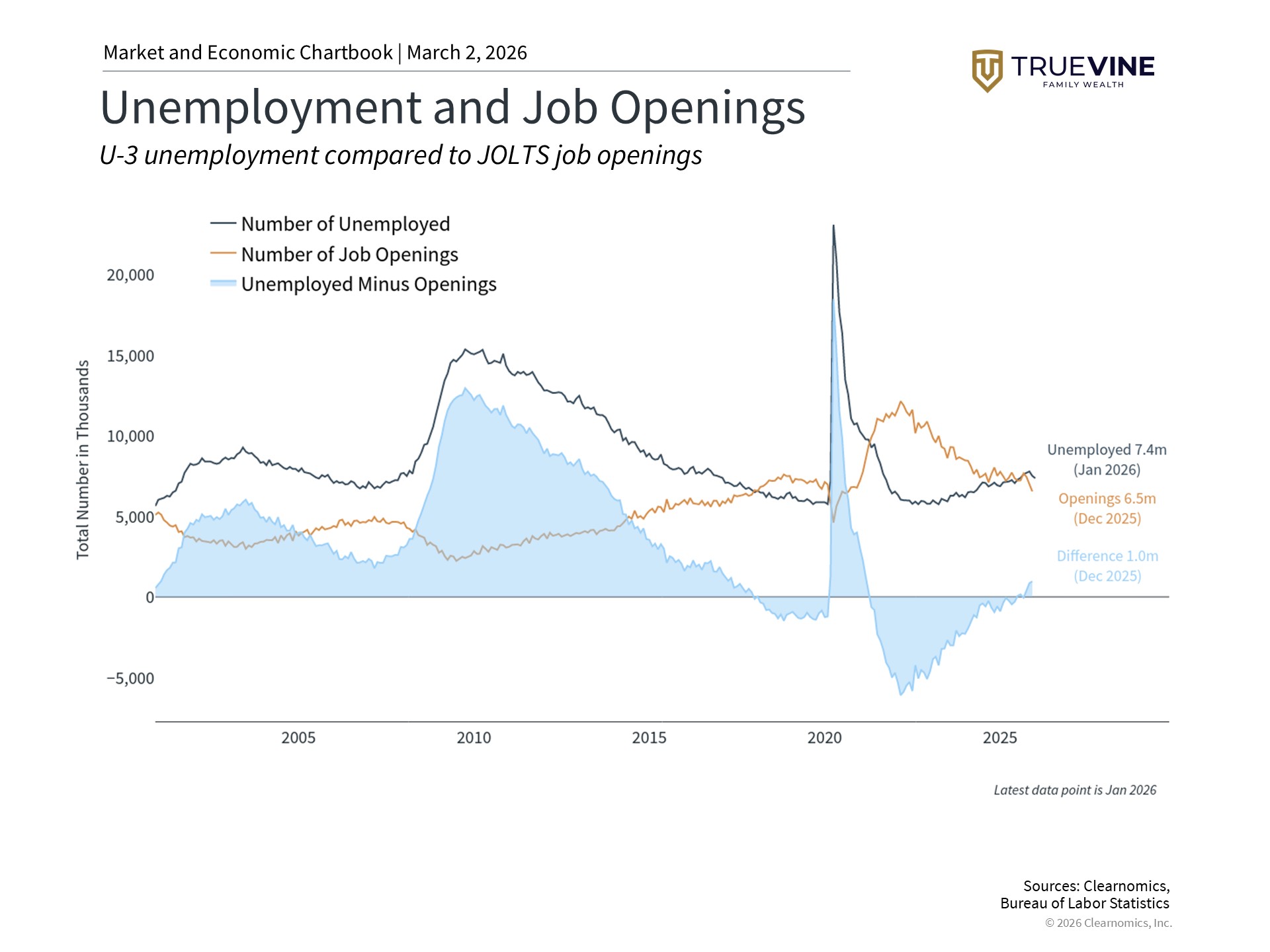
One important shift in the job market is the balance between people looking for work and the number of available positions. After the pandemic, there were far more job openings than job seekers — at one point, there were nearly two openings for every unemployed person in 2022. Today, that balance has flipped: there are about 7.4 million unemployed Americans but only 6.5 million job openings, the lowest number of unfilled roles since late 2020.
The most recent monthly jobs report was encouraging, showing that 130,000 jobs were added — nearly double what was expected. The unemployment rate also dipped slightly to 4.3%. However, a broader government review revealed that job creation across all of 2025 totaled only 181,000, or roughly 15,000 per month — the weakest annual total since 2020. Despite slower hiring, the unemployment rate has stayed relatively low partly because fewer people are entering the workforce, due to an aging population and a decline in immigration.
Jobs, Inflation, And The Broader Economy
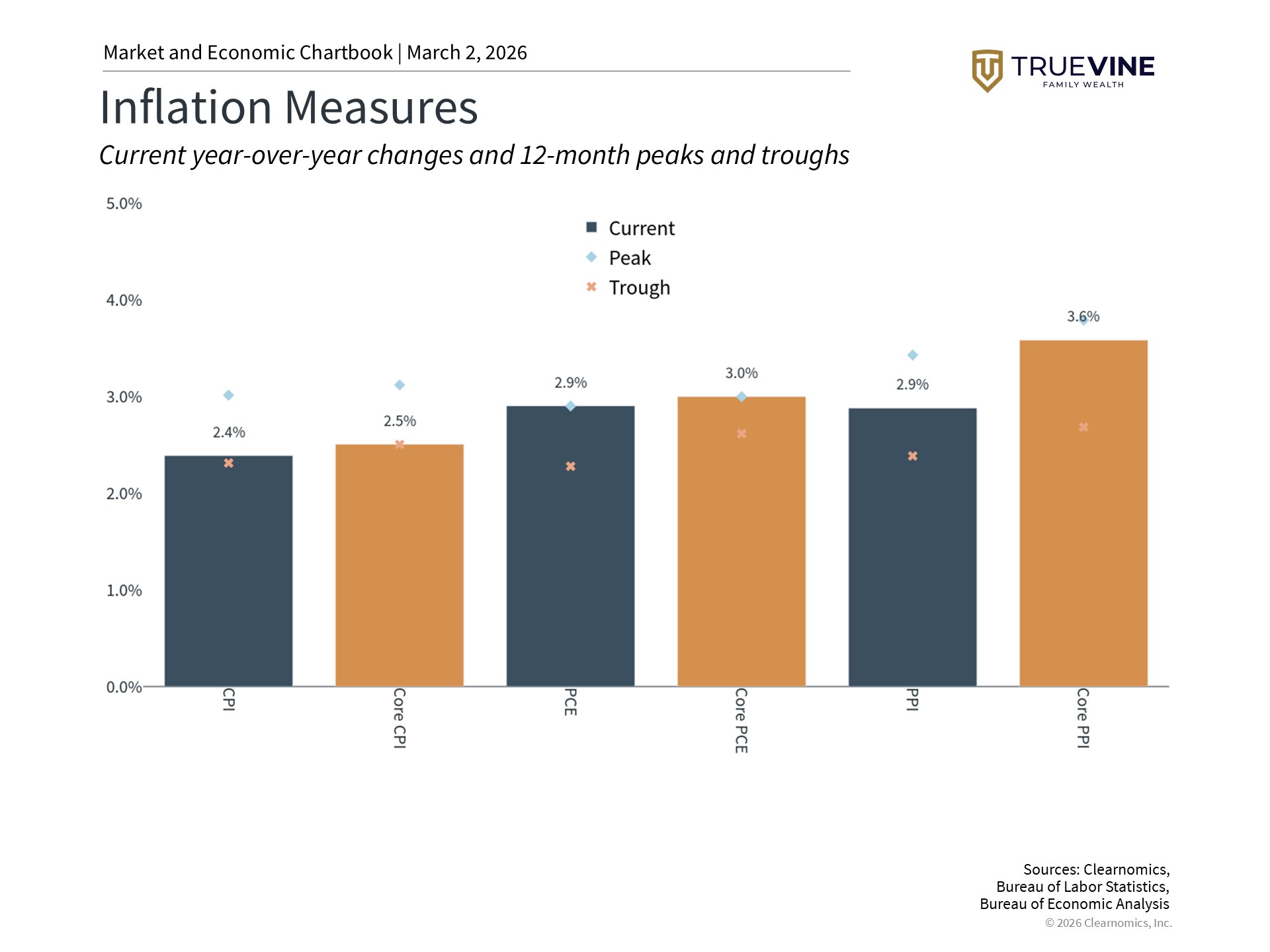
Inflation has been steadily cooling toward the Fed’s target.
Jobs matter to investors because they directly affect how much money households earn and spend. Consumer spending makes up more than two-thirds of U.S. economic output (GDP), so changes in the labor market ripple through the broader economy.
Inflation — the rate at which prices rise — is also a key indicator. The latest data show that overall prices rose just 2.4% over the past year, while core inflation (which excludes food and energy) slowed to 2.5%, the lowest in nearly five years. This brings the Federal Reserve (the U.S. central bank) closer to its 2% inflation goal. While prices haven’t actually come down, the slowdown in price increases is a positive sign for both stocks and bonds.
What This Means For Your Portfolio
A balanced economy can support both stocks and bonds

The current mix of steady growth, cooling inflation, and a softening job market can create a “Goldilocks” environment — not too hot, not too cold. This kind of backdrop can be positive for both stocks and bonds. Interest rates have already moved lower in response to recent data, with the 10-year U.S. Treasury yield sitting just above 4%.
Markets currently expect at least two interest rate cuts this year from the Fed, and the prospect of a new Fed chair appointed by President Trump adds to that possibility. Lower interest rates can benefit investors by reducing borrowing costs for businesses, boosting corporate earnings, and making existing bonds more valuable. Even if rates stay where they are, bonds still offer solid returns and can help cushion portfolios over time.

This blog is published by TrueVine Family Wealth. The firm is registered as an investment adviser with the state of Florida and only conducts business in states where it is properly registered or is excluded from registration requirements. Registration is not an endorsement of the firm by securities regulators and does not mean the adviser has achieved a specific level of skill or ability. The firm is not engaged in the practice of law or accounting.
Information presented is believed to be factual and up-to-date, but we do not guarantee its accuracy and it should not be regarded as a complete analysis of any subjects discussed. All expressions of opinion reflect the judgment of the authors on the date of the post and are subject to change. Blog posts were prepared by Clearnomics, a third-party content provider.
You should consult with a professional advisor before implementing any strategies discussed. Content should not be viewed as an offer to buy or sell any of the securities mentioned or as legal or tax advice. You should always consult an attorney or tax professional regarding your specific legal or tax situation. Estate planning rules and regulations are subject to change at any time.
All investments have the potential for profit or loss. Different types of investments and strategies involve higher and lower levels of risk. There is no guarantee that a specific investment or strategy will be suitable or profitable for an investor’s portfolio. Asset allocation, rebalancing, and diversification will not necessarily improve a client’s returns and cannot eliminate the risk of investment losses.
Historical performance returns for investment indexes and/or categories, usually do not deduct transaction and/or custodial charges or an advisory fee, which would decrease historical performance results. There are no guarantees that an investor’s portfolio will match or outperform a specific benchmark. Historical returns do not represent the performance of TrueVine or any of its advisory clients.
Copyright (c) 2026 Clearnomics, Inc. All rights reserved. The information contained herein has been obtained from sources believed to be reliable, but is not necessarily complete and its accuracy cannot be guaranteed. No representation or warranty, express or implied, is made as to the fairness, accuracy, completeness, or correctness of the information and opinions contained herein. The views and the other information provided are subject to change without notice. All reports posted on or via www.clearnomics.com or any affiliated websites, applications, or services are issued without regard to the specific investment objectives, financial situation, or particular needs of any specific recipient and are not to be construed as a solicitation or an offer to buy or sell any securities or related financial instruments. Past performance is not necessarily a guide to future results. Company fundamentals and earnings may be mentioned occasionally, but should not be construed as a recommendation to buy, sell, or hold the company’s stock. Predictions, forecasts, and estimates for any and all markets should not be construed as recommendations to buy, sell, or hold any security–including mutual funds, futures contracts, and exchange traded funds, or any similar instruments. The text, images, and other materials contained or displayed in this report are proprietary to Clearnomics, Inc. and constitute valuable intellectual property. All unauthorized reproduction or other use of material from Clearnomics, Inc. shall be deemed willful infringement(s) of this copyright and other proprietary and intellectual property rights, including but not limited to, rights of privacy. Clearnomics, Inc. expressly reserves all rights in connection with its intellectual property, including without limitation the right to block the transfer of its products and services and/or to track usage thereof, through electronic tracking technology, and all other lawful means, now known or hereafter devised. Clearnomics, Inc. reserves the right, without further notice, to pursue to the fullest extent allowed by the law any and all criminal and civil remedies for the violation of its rights.