
February Market Update: What the Supreme Court Tariff Decision, AI Shifts, and Middle East Tensions Mean for Your Portfolio


February served as a reminder that markets rarely move in one direction for long. After a strong start to the year, sentiment shifted due to a major Supreme Court ruling on tariffs, worries about artificial intelligence (AI), and rising tensions in the Middle East. Despite this, international stocks (shares of companies outside the U.S.) and small-cap stocks (shares of smaller companies) continued to do well, and bonds (loans made to governments or companies that pay back interest) also gained. This highlights why holding a mix of different investments is so important.
While news headlines can cause short-term market swings, the overall economy remains in good shape and company profits continue to grow. Investors are best served by staying the course with a diversified portfolio — one that spreads investments across different types of assets — aligned with their long-term financial goals.
Key Market and Economic Highlights for February
- The S&P 500 fell -0.9% and the Nasdaq Composite dropped -3.4% for the month. The Dow Jones Industrial Average rose 0.2%.
- The CBOE VIX volatility index — a measure of how much market swings are expected — rose to 19.9 at month-end due to AI concerns and trade policy uncertainty.
- International developed markets jumped 4.5% (MSCI EAFE Index in U.S. dollar terms), while emerging markets gained 5.4% (MSCI EM Index). Year-to-date, they have gained 9.9% and 14.6%, respectively.
- U.S. small cap stocks gained 0.7% based on the Russell 2000.
- The 10-year Treasury yield — the interest rate on U.S. government bonds — fell to 3.95%, the first time below 4% since last November. The Bloomberg Aggregate Bond Index rose 1.6%.
- Gold closed lower at $5,279 per ounce but reached as low as $4,661 at the beginning of the month. Silver ended lower at $93.79 per month.
- The U.S. dollar index rose slightly to 97.6.
- January inflation showed headline CPI at 2.4% year-over-year and core CPI at 2.5%, while the core PCE price index rose 0.4% month-over-month, the sharpest increase in a year.
- The unemployment rate edged down to 4.3% in January, with 130,000 jobs added. However, annual revisions showed the economy created only 181,000 jobs in all of 2025, roughly 15,000 per month.
- On February 20, the Supreme Court ruled against the administration’s use of IEEPA-based reciprocal tariffs, prompting a shift to alternative trade laws.
- On February 28, the U.S. and Israel launched military strikes against Iran, including the compound of Iran’s Supreme Leader who has been reported killed.
The Supreme Court Ruling Changed How Tariffs Are Applied
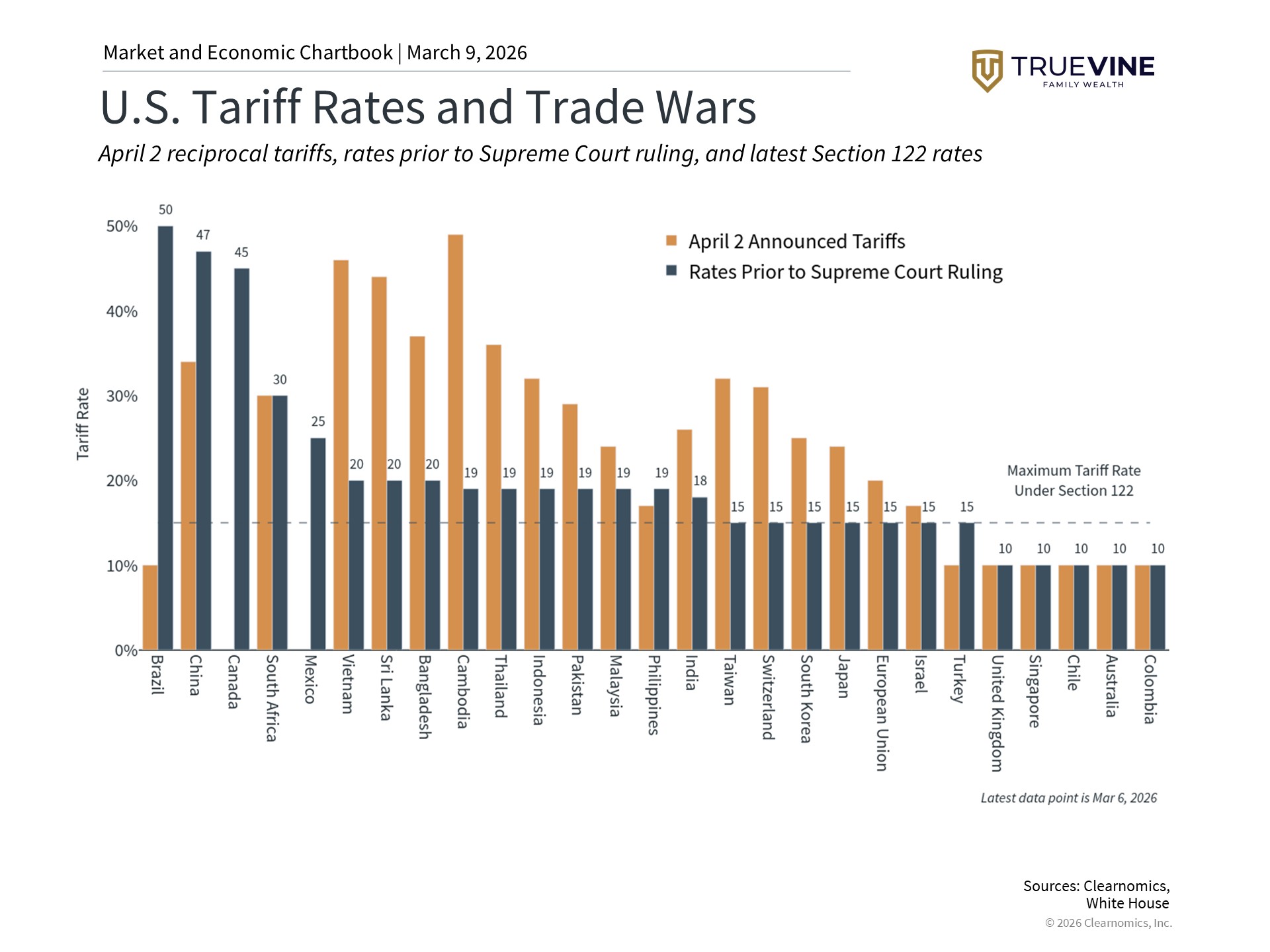
The biggest policy event in February was the Supreme Court’s ruling on February 20 against tariffs that were put in place using the International Emergency Economic Powers Act (IEEPA). Tariffs are charges placed on imported goods from other countries. The Court’s decision could mean refunds for some businesses and consumers who paid these tariffs.
After the ruling, the White House quickly shifted to using a different law — Section 122 of the Trade Act of 1974 — which allows tariffs of up to 15% for 150 days. These new import charges took effect on February 24. While the legal basis for tariffs has changed, the overall direction of trade policy has not. Trade-related uncertainty is likely to keep generating market headlines, though history shows that markets tend to adapt over time as companies adjust their strategies.
Ai Excitement Meets Valuation Concerns
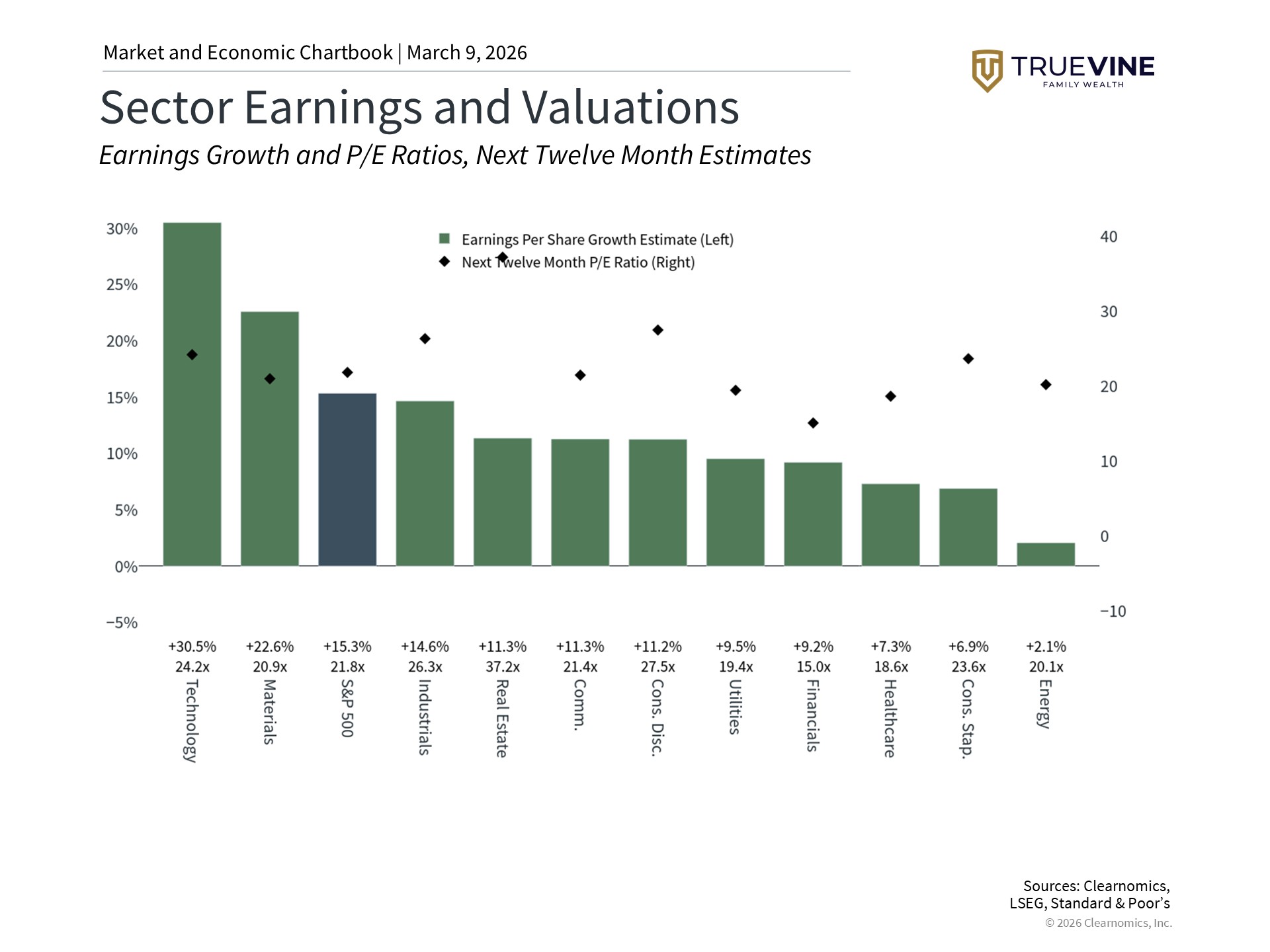
AI remained a major topic in February, but the conversation shifted. Some investors began worrying that AI could hurt the profits of software companies and disrupt traditional business models faster than expected. This led many to move money away from large technology stocks and into sectors seen as harder to replace, such as energy, materials, and industrials. This shift helps explain why the Nasdaq — which is heavily weighted toward technology companies — fell, while other parts of the market rose.
On the economic front, real GDP (the total value of goods and services produced, adjusted for inflation) grew at an annual rate of 1.4% in the fourth quarter of 2025, down from 4.4% the prior quarter. For all of 2025, real GDP grew 2.2%, which is still healthy. However, job creation was much weaker than expected, with only about 15,000 jobs added per month on average in 2025. This gap between economic growth and job creation has raised questions about the strength of the current expansion.
International Stocks And Small Caps Outperformed
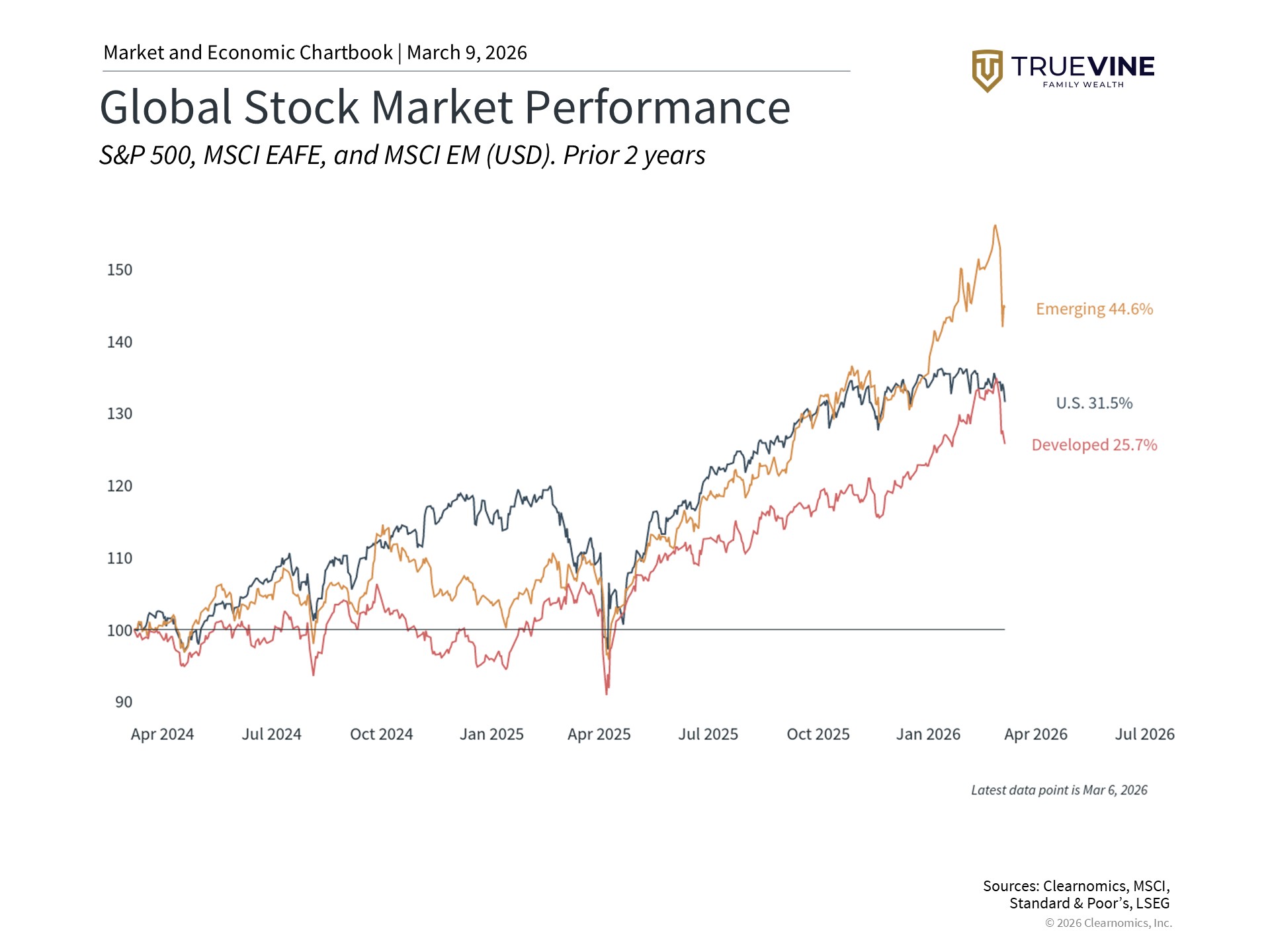
One of the most encouraging trends in February was the strong performance of investments beyond large U.S. technology stocks. International developed markets rose nearly 5% and emerging markets gained over 5%. U.S. small cap stocks were also up, with the Russell 2000 surging roughly 5% year-to-date, well ahead of the S&P 500. This broadening of returns is a positive sign for investors who hold a diversified mix of assets.
Precious metals also performed well earlier in the period, with gold and silver gaining 6.8% and 8.1%, respectively, though both ended the month lower. These gains reflected geopolitical uncertainty and concerns about government spending. Meanwhile, escalating U.S.-Iran tensions and reports surrounding the death of Iran’s supreme leader, Ali Khamenei, added to market uncertainty. History shows that staying invested through periods of geopolitical stress has generally been the best approach.

This blog is published by TrueVine Family Wealth. The firm is registered as an investment adviser with the state of Florida and only conducts business in states where it is properly registered or is excluded from registration requirements. Registration is not an endorsement of the firm by securities regulators and does not mean the adviser has achieved a specific level of skill or ability. The firm is not engaged in the practice of law or accounting.
Information presented is believed to be factual and up-to-date, but we do not guarantee its accuracy and it should not be regarded as a complete analysis of any subjects discussed. All expressions of opinion reflect the judgment of the authors on the date of the post and are subject to change. Blog posts were prepared by Clearnomics, a third-party content provider.
You should consult with a professional advisor before implementing any strategies discussed. Content should not be viewed as an offer to buy or sell any of the securities mentioned or as legal or tax advice. You should always consult an attorney or tax professional regarding your specific legal or tax situation. Estate planning rules and regulations are subject to change at any time.
All investments have the potential for profit or loss. Different types of investments and strategies involve higher and lower levels of risk. There is no guarantee that a specific investment or strategy will be suitable or profitable for an investor’s portfolio. Asset allocation, rebalancing, and diversification will not necessarily improve a client’s returns and cannot eliminate the risk of investment losses.
Historical performance returns for investment indexes and/or categories, usually do not deduct transaction and/or custodial charges or an advisory fee, which would decrease historical performance results. There are no guarantees that an investor’s portfolio will match or outperform a specific benchmark. Historical returns do not represent the performance of TrueVine or any of its advisory clients.
Copyright (c) 2026 Clearnomics, Inc. All rights reserved. The information contained herein has been obtained from sources believed to be reliable, but is not necessarily complete and its accuracy cannot be guaranteed. No representation or warranty, express or implied, is made as to the fairness, accuracy, completeness, or correctness of the information and opinions contained herein. The views and the other information provided are subject to change without notice. All reports posted on or via www.clearnomics.com or any affiliated websites, applications, or services are issued without regard to the specific investment objectives, financial situation, or particular needs of any specific recipient and are not to be construed as a solicitation or an offer to buy or sell any securities or related financial instruments. Past performance is not necessarily a guide to future results. Company fundamentals and earnings may be mentioned occasionally, but should not be construed as a recommendation to buy, sell, or hold the company’s stock. Predictions, forecasts, and estimates for any and all markets should not be construed as recommendations to buy, sell, or hold any security–including mutual funds, futures contracts, and exchange traded funds, or any similar instruments. The text, images, and other materials contained or displayed in this report are proprietary to Clearnomics, Inc. and constitute valuable intellectual property. All unauthorized reproduction or other use of material from Clearnomics, Inc. shall be deemed willful infringement(s) of this copyright and other proprietary and intellectual property rights, including but not limited to, rights of privacy. Clearnomics, Inc. expressly reserves all rights in connection with its intellectual property, including without limitation the right to block the transfer of its products and services and/or to track usage thereof, through electronic tracking technology, and all other lawful means, now known or hereafter devised. Clearnomics, Inc. reserves the right, without further notice, to pursue to the fullest extent allowed by the law any and all criminal and civil remedies for the violation of its rights.